
Data Engineering Topic
Data Engineering Introduction
What is Data Engineering?
Data Engineering is the practice of designing, building, and maintaining systems and infrastructure that collect, store, process, and deliver data for analytical use. Data engineers create the "pipelines" that move data from source systems to data warehouses and data lakes, making data accessible, reliable, and usable for data scientists, analysts, and business users.
The Data Engineering Mindset:
"If Data Science is about asking interesting questions and finding answers, Data Engineering is about building the highway system that allows the data to reach the question-askers efficiently and reliably."
1. The Data Engineering Landscape
Key Roles & Responsibilities:
-
Data Infrastructure: Building and maintaining data platforms
-
Data Pipelines: Designing ETL/ELT processes
-
Data Modeling: Structuring data for analytical use
-
Data Quality & Governance: Ensuring data reliability and compliance
-
Performance Optimization: Scaling systems for large data volumes
The Data Hierarchy of Needs:
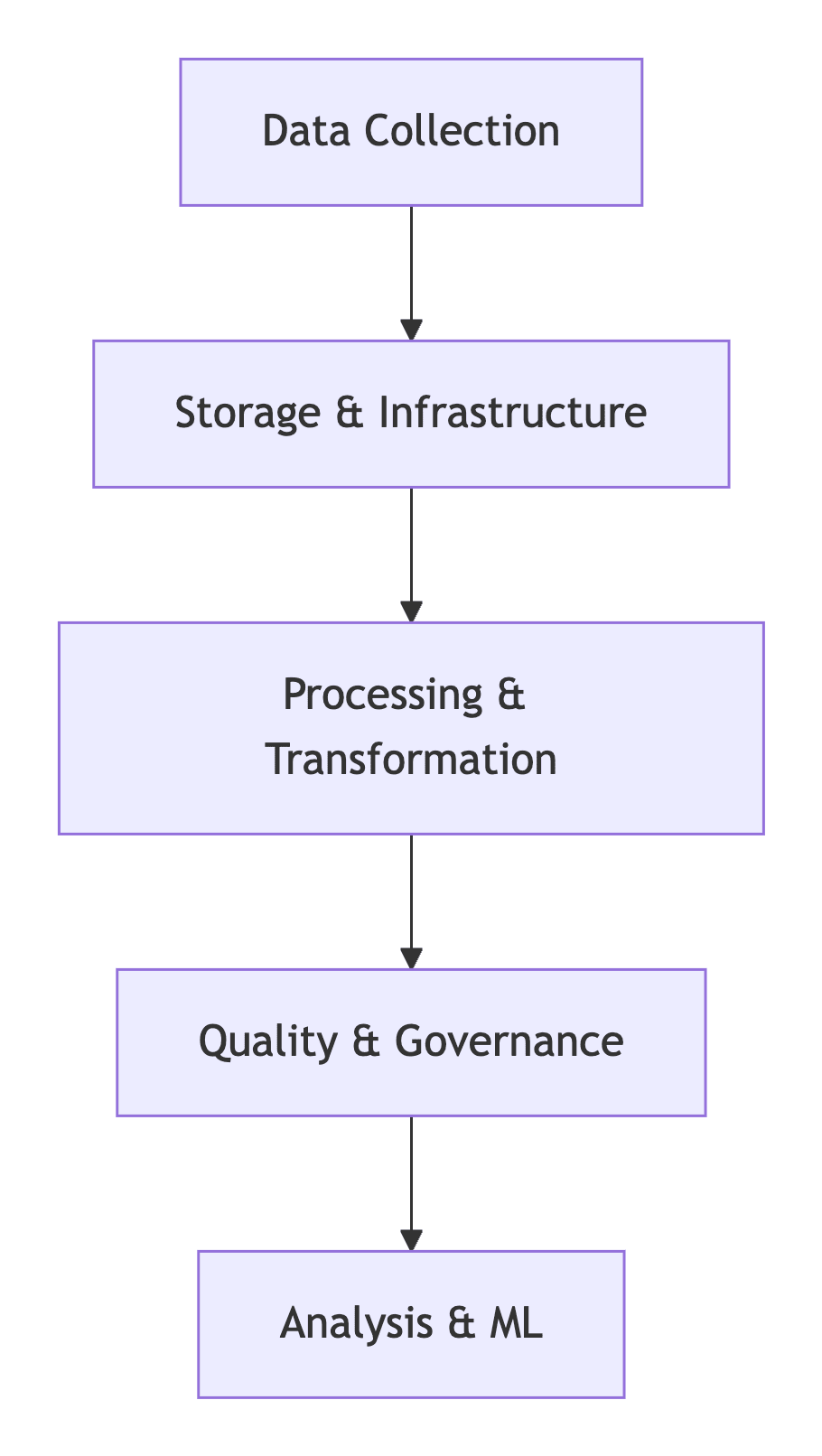
2. Core Concepts & Architecture
The Modern Data Stack
python
# Conceptual architecture of a modern data platform
class ModernDataStack:
    def __init__(self):
        self.ingestion_tools = ['Fivetran', 'Airbyte', 'Stitch']
        self.warehouses = ['Snowflake', 'BigQuery', 'Redshift']
        self.transformation_tools = ['dbt', 'Dataform']
        self.orchestration = ['Airflow', 'Dagster', 'Prefect']
        self.bi_tools = ['Tableau', 'Looker', 'Power BI']

    def describe_flow(self):
        return """
        Data Flow:
        1. Extraction: Pull data from sources (APIs, Databases, Files)
        2. Loading: Store raw data in data lake/warehouse
        3. Transformation: Clean, enrich, model data for analysis
        4. Orchestration: Schedule and monitor pipeline execution
        5. Consumption: Serve data to BI tools, ML models, applications
        """
Data Architecture Patterns
Batch Processing
python
# Traditional ETL (Extract, Transform, Load)
class BatchETL:
    def extract(self):
        """Extract data from source systems"""
        # Examples: Database queries, API calls, file reads
        source_data = self.query_database("SELECT * FROM sales")
        return source_data

    def transform(self, raw_data):
        """Clean, validate, and transform data"""
        cleaned_data = self.clean_records(raw_data)
        enriched_data = self.join_with_reference_data(cleaned_data)
        aggregated_data = self.aggregate_metrics(enriched_data)
        return aggregated_data

    def load(self, transformed_data):
        """Load transformed data to destination"""
        self.write_to_warehouse(transformed_data)
        self.update_data_catalog(transformed_data)
Stream Processing
python
# Real-time data processing
class StreamProcessor:
    def __init__(self):
        self.kafka_consumer = KafkaConsumer('user-events')
        self.spark_streaming = SparkSession.builder.getOrCreate()

    def process_stream(self):
        """Process real-time data streams"""
        for message in self.kafka_consumer:
            # Real-time transformations
            enriched_event = self.enrich_with_user_data(message.value)
            validated_event = self.validate_event(enriched_event)

            # Write to multiple sinks
            self.write_to_data_lake(validated_event)
            self.update_real_time_dashboard(validated_event)
            self.trigger_downstream_alerts(validated_event)
Lambda Architecture
python
# Combining batch and stream processing
class LambdaArchitecture:
    def __init__(self):
        self.batch_layer = BatchProcessor()
        self.speed_layer = StreamProcessor()
        self.serving_layer = QueryEngine()

    def process_data(self, data):
        """Process data through both batch and speed layers"""
        # Batch layer (accurate but high latency)
        batch_view = self.batch_layer.process(data)

        # Speed layer (approximate but low latency)
        real_time_view = self.speed_layer.process(data)

        # Serving layer combines both views
        return self.serving_layer.merge_views(batch_view, real_time_view)
3. Key Technologies & Tools
Data Ingestion
Batch Ingestion:
-
Apache NiFi: GUI-based data flow management
-
Airbyte: Open-source ELT platform
-
Fivetran: Managed data connectors
Stream Ingestion:
-
Apache Kafka: Distributed event streaming platform
-
AWS Kinesis: Managed real-time data streaming
-
Google Pub/Sub: Message ingestion and delivery
Data Storage
Data Warehouses:
-
Snowflake: Cloud-native data warehouse
-
Google BigQuery: Serverless, highly scalable data warehouse
-
Amazon Redshift: Cloud data warehouse
-
Databricks Lakehouse: Unified analytics platform
Data Lakes:
-
Amazon S3: Object storage for data lakes
-
Azure Data Lake Storage: Optimized storage for analytics
-
Google Cloud Storage: Unified object storage
Data Processing & Transformation
Batch Processing:
-
Apache Spark: Unified analytics engine for large-scale data processing
-
dbt (data build tool): Transformation workflow tool
-
Apache Hive: Data warehouse software for querying and managing large datasets
Stream Processing:
-
Apache Flink: Framework for stateful computations over data streams
-
Apache Spark Streaming: Spark's stream processing component
-
ksqlDB: Streaming SQL engine for Apache Kafka
Orchestration & Workflow
python
# Example Apache Airflow DAG (Directed Acyclic Graph)
from airflow import DAG
from airflow.operators.python_operator import PythonOperator
from datetime import datetime, timedelta

default_args = {
    'owner': 'data_engineering',
    'depends_on_past': False,
    'start_date': datetime(2024, 1, 1),
    'retries': 1,
    'retry_delay': timedelta(minutes=5)
}

def extract_data():
    # Extract data from source
    pass

def transform_data():
    # Transform and clean data
    pass

def load_data():
    # Load to data warehouse
    pass

with DAG('etl_pipeline',
         default_args=default_args,
         schedule_interval='@daily',
         catchup=False) as dag:

    extract_task = PythonOperator(
        task_id='extract_data',
        python_callable=extract_data
    )

    transform_task = PythonOperator(
        task_id='transform_data',
        python_callable=transform_data
    )

    load_task = PythonOperator(
        task_id='load_data',
        python_callable=load_data
    )

    extract_task >> transform_task >> load_task
4. Data Modeling for Analytics
Dimensional Modeling (Kimball)
sql
-- Star Schema Example
-- Fact Table (measures/events)
CREATE TABLE fact_sales (
    sale_id BIGINT,
    date_key INT,
    product_key INT,
    customer_key INT,
    store_key INT,
    quantity_sold INT,
    sale_amount DECIMAL(10,2),
    tax_amount DECIMAL(10,2)
);

-- Dimension Tables (descriptive attributes)
CREATE TABLE dim_date (
    date_key INT PRIMARY KEY,
    full_date DATE,
    day_of_week INT,
    month INT,
    quarter INT,
    year INT,
    is_weekend BOOLEAN
);

CREATE TABLE dim_product (
    product_key INT PRIMARY KEY,
    product_name VARCHAR(100),
    category VARCHAR(50),
    brand VARCHAR(50),
    price DECIMAL(10,2)
);
Modern Data Modeling Approaches
python
# Data Vault 2.0 Modeling
class DataVaultModel:
    def create_hubs(self):
        """Business keys"""
        return {
            'hub_customer': ['customer_id', 'load_date', 'record_source'],
            'hub_product': ['product_id', 'load_date', 'record_source']
        }

    def create_satellites(self):
        """Descriptive attributes"""
        return {
            'sat_customer_details': ['customer_id', 'load_date', 'name', 'email', 'phone'],
            'sat_product_details': ['product_id', 'load_date', 'product_name', 'category']
        }

    def create_links(self):
        """Relationships between business keys"""
        return {
            'link_customer_order': ['customer_order_id', 'customer_id', 'order_id', 'load_date']
        }
5. Building Data Pipelines
ETL vs ELT
ETL (Extract, Transform, Load):
-
Transformations happen before loading to destination
-
Better for structured data with complex transformations
-
Uses separate processing engine
ELT (Extract, Load, Transform):
-
Raw data loaded first, transformations happen in destination
-
Leverages power of modern cloud data warehouses
-
More flexible for changing business requirements
Complete Pipeline Example
python
import pandas as pd
from sqlalchemy import create_engine
from datetime import datetime
import logging

class DataPipeline:
    def __init__(self):
        self.source_conn = create_engine('postgresql://source_db')
        self.warehouse_conn = create_engine('snowflake://warehouse')
        self.logger = logging.getLogger(__name__)

    def run_daily_pipeline(self):
        """Complete daily ETL pipeline"""
        try:
            # Extract
            raw_data = self.extract_data()
            self.logger.info(f"Extracted {len(raw_data)} records")

            # Transform
            cleaned_data = self.clean_data(raw_data)
            enriched_data = self.enrich_data(cleaned_data)
            aggregated_data = self.aggregate_data(enriched_data)

            # Load
            self.load_to_warehouse(aggregated_data)
            self.update_metadata()

            self.logger.info("Pipeline completed successfully")

        except Exception as e:
            self.logger.error(f"Pipeline failed: {str(e)}")
            self.send_alert(f"Pipeline failure: {str(e)}")

    def extract_data(self):
        """Extract data from source systems"""
        query = """
        SELECT user_id, order_date, amount, product_id, status
        FROM orders
        WHERE order_date >= CURRENT_DATE - INTERVAL '1 day'
        """
        return pd.read_sql(query, self.source_conn)

    def clean_data(self, df):
        """Data cleaning and validation"""
        # Remove duplicates
        df = df.drop_duplicates()

        # Handle missing values
        df['amount'] = df['amount'].fillna(0)

        # Validate data
        df = df[df['amount'] >= 0]  # Remove negative amounts

        return df

    def enrich_data(self, df):
        """Enrich with additional data"""
        # Add derived columns
        df['order_day_of_week'] = pd.to_datetime(df['order_date']).dt.day_name()
        df['amount_category'] = pd.cut(df['amount'],
                                     bins=[0, 50, 100, float('inf')],
                                     labels=['Small', 'Medium', 'Large'])

        return df

    def aggregate_data(self, df):
        """Create aggregated datasets"""
        daily_metrics = df.groupby('order_date').agg({
            'user_id': 'nunique',
            'amount': ['sum', 'mean', 'count']
        }).reset_index()

        daily_metrics.columns = ['order_date', 'unique_users', 'total_revenue',
                               'avg_order_value', 'total_orders']

        return daily_metrics

    def load_to_warehouse(self, df):
        """Load transformed data to data warehouse"""
        df.to_sql('daily_sales_metrics', self.warehouse_conn,
                 if_exists='append', index=False)
6. Data Quality & Testing
Data Quality Framework
python
class DataQualityFramework:
    def __init__(self):
        self.checks = []

    def add_check(self, check_name, query, expected_condition):
        self.checks.append({
            'name': check_name,
            'query': query,
            'expected': expected_condition
        })

    def run_quality_checks(self):
        """Execute all data quality checks"""
        results = []

        for check in self.checks:
            try:
                result = self.execute_check(check)
                results.append(result)

                if not result['passed']:
                    self.trigger_alert(f"Data quality check failed: {check['name']}")

            except Exception as e:
                results.append({
                    'check': check['name'],
                    'passed': False,
                    'error': str(e)
                })

        return results

    def execute_check(self, check):
        """Execute a single data quality check"""
        # Example checks:
        # - Freshness: Is data updated recently?
        # - Completeness: Are required fields populated?
        # - Uniqueness: No duplicate records?
        # - Validity: Does data conform to expected format?
        # - Accuracy: Does data match source systems?

        query_result = self.run_query(check['query'])
        passed = self.evaluate_condition(query_result, check['expected'])

        return {
            'check': check['name'],
            'passed': passed,
            'result': query_result
        }

# Example usage
dq = DataQualityFramework()

# Add data quality checks
dq.add_check(
    'freshness_check',
    "SELECT MAX(order_date) FROM orders",
    ">= CURRENT_DATE - INTERVAL '1 day'"
)

dq.add_check(
    'completeness_check',
    "SELECT COUNT(*) FROM orders WHERE user_id IS NULL",
    "= 0"
)

dq.add_check(
    'uniqueness_check',
    "SELECT COUNT(*) FROM (SELECT user_id, order_date, COUNT(*) FROM orders GROUP BY 1,2 HAVING COUNT(*) > 1)",
    "= 0"
)
7. Cloud Data Platforms
AWS Data Stack
python
class AWSDataStack:
    def __init__(self):
        self.ingestion = {
            'batch': 'AWS Glue',
            'streaming': 'Kinesis',
            'orchestration': 'Step Functions + Lambda'
        }
        self.storage = {
            'data_lake': 'S3',
            'warehouse': 'Redshift',
            'catalog': 'Glue Data Catalog'
        }
        self.processing = {
            'etl': 'AWS Glue',
            'batch': 'EMR Spark',
            'streaming': 'Kinesis Analytics'
        }

    def architecture(self):
        return """
        AWS Data Architecture:
        Sources → Kinesis/Glue → S3 (Raw) → Glue ETL → Redshift/S3 (Processed)
                          ↓
                    QuickSight (BI)
        """
Modern Data Stack Example
python
class ModernDataStackImplementation:
    def __init__(self):
        self.components = {
            'ingestion': 'Fivetran + Airbyte',
            'warehouse': 'Snowflake',
            'transformation': 'dbt',
            'orchestration': 'Airflow',
            'bi': 'Tableau',
            'reverse_etl': 'Hightouch'
        }

    def build_pipeline(self):
        pipeline = """
        Modern Data Pipeline:
        1. Fivetran: Sync data from SaaS apps to Snowflake
        2. dbt: Transform raw data into analytics-ready models
        3. Airflow: Orchestrate and schedule pipeline runs
        4. Tableau: Connect to Snowflake for visualization
        5. Hightouch: Sync insights back to operational tools
        """
        return pipeline
8. Essential Skills for Data Engineers
Technical Skills
Programming:
-
Python: Primary language for data processing
-
SQL: Essential for data manipulation and analysis
-
Scala/Java: For big data frameworks like Spark
Databases & Storage:
-
Relational Databases (PostgreSQL, MySQL)
-
NoSQL Databases (MongoDB, Cassandra)
-
Data Warehouses (Snowflake, BigQuery, Redshift)
-
Data Lakes (S3, ADLS, GCS)
Big Data Technologies:
-
Apache Spark, Hadoop ecosystem
-
Streaming platforms (Kafka, Flink)
-
Orchestration tools (Airflow, Prefect, Dagster)
Cloud Platforms:
-
AWS, Azure, or GCP certifications
-
Infrastructure as Code (Terraform, CloudFormation)
Soft Skills
-
Problem-solving: Debugging complex data issues
-
Communication: Explaining technical concepts to non-technical stakeholders
-
Data modeling: Designing efficient data structures
-
System design: Architecting scalable data platforms
9. Common Data Engineering Patterns
Medallion Architecture
python
class MedallionArchitecture:
    def __init__(self):
        self.layers = {
            'bronze': 'Raw data from sources',
            'silver': 'Cleaned, validated, enriched data',
            'gold': 'Business-level aggregates and metrics'
        }

    def process_layer(self, layer_name, data):
        if layer_name == 'bronze':
            return self.store_raw(data)
        elif layer_name == 'silver':
            return self.clean_and_validate(data)
        elif layer_name == 'gold':
            return self.create_business_metrics(data)
Data Mesh Principles
python
class DataMeshImplementation:
    def __init__(self):
        self.domains = ['marketing', 'sales', 'product', 'finance']
        self.platform_team = 'Central data platform team'

    def principles(self):
        return {
            'domain_ownership': 'Business domains own their data',
            'data_as_product': 'Treat data as a product',
            'self_service': 'Provide self-service data infrastructure',
            'federated_governance': 'Global standards with local control'
        }
10. Real-World Project Example
E-Commerce Data Platform
python
class EcommerceDataPlatform:
    def __init__(self):
        self.sources = ['web_events', 'orders', 'products', 'customers']
        self.pipelines = {
            'user_behavior': self.build_user_behavior_pipeline(),
            'product_analytics': self.build_product_analytics_pipeline(),
            'financial_reporting': self.build_financial_pipeline()
        }

    def build_user_behavior_pipeline(self):
        return """
        User Behavior Pipeline:
        1. Collect clickstream data from website
        2. Enrich with user demographics
        3. Calculate session metrics and conversion rates
        4. Load to customer 360 view for marketing teams
        """

    def daily_operations(self):
        tasks = [
            'Monitor data freshness and quality',
            'Process incremental data loads',
            'Update derived tables and aggregates',
            'Generate business intelligence reports',
            'Handle schema changes and new data sources'
        ]
        return tasks
Career Path & Learning Journey
Entry-Level → Senior Data Engineer
-
Junior DE: SQL, Python, basic ETL pipelines
-
Data Engineer: Spark, cloud platforms, data modeling
-
Senior DE: System architecture, team leadership, strategy
-
Principal/Staff DE: Organization-wide data strategy, platform design
Learning Resources
-
Books: "Fundamentals of Data Engineering", "Designing Data-Intensive Applications"
-
Courses: Data Engineering on AWS/Azure/GCP, Spark specialization
-
Practice: Build personal projects, contribute to open source
-
Certifications: Cloud provider certifications, vendor-specific training
Data engineering is a critical and rapidly evolving field that sits at the intersection of software engineering, data science, and infrastructure. It requires both technical depth and business understanding to build systems that turn raw data into valuable business insights.


Comments (0)
No comments yet. Be the first to comment!