
Other Topic
11 Stories of Ganesha, Krishna and Prahlada – Part 3
These are simple retellings of traditional Hindu stories. Families may tell them in different ways. The English versions add scenes and dialogue. They do not claim to be the only telling.
Each English story, lesson and reader question takes about three minutes at a slow pace of about 120 words a minute. Your reading time may be different.
The earlier short Hindi and German versions are kept below each story, where available. They may use different details or endings. Open the language section you want to read.
Choose a story
- Ganesha and Kartikeya: A Journey Around the World
- Krishna and the Butter
- Narasimha Protects Prahlada
- Ganesha and the Broken Tusk
- Krishna and Kaliya
- Ganesha and the Moon
- Krishna Lifts Govardhan Hill
- Prahlada Learns to Lead with Kindness
- Ganesha and Kubera’s Feast
- Krishna and Sudama
- How Ganesha Received an Elephant’s Head
1. Ganesha and Kartikeya: A Journey Around the World

English story
One morning, Ganesha and Kartikeya sat with their parents, Shiva and Parvati. A special fruit lay between them.
“This fruit is for wisdom,” Shiva said. “Who can make a journey around the world?”
Kartikeya looked at his peacock. He was ready for a long adventure. He imagined rivers, high mountains and places beyond the clouds.
“I will go now,” he said.
Soon he was far away, flying over forests and seas. At each place, he saw something new. He did not want to lose a moment.
Ganesha stayed beside his parents. His small mouse waited near his feet.
He knew he could not make the same fast journey. At first, he looked at the road and felt unsure.
Then he stopped thinking about speed. What did the journey mean? What had his parents taught him about the world?
He remembered learning his first words. He remembered being fed, cared for and guided when he was afraid.
Ganesha stood and slowly walked around Shiva and Parvati. He did this three times. Then he bowed.
Parvati smiled. “Why did you walk around us?”
“You help me understand the world,” he replied. “For me, you are at the centre of it.”
Shiva saw that Ganesha had thought carefully about the question. He gave him the fruit.
When Kartikeya returned, he was surprised. He had crossed great distances. Ganesha had barely left home.
Shiva listened to the story of his journey too. The lesson was not that travel or effort had no value. Both sons had used a different kind of strength.
Kartikeya had seen faraway places. Ganesha had looked closely at love and care near him.
The brothers sat together. One shared stories of the world. The other shared the fruit.
The lesson: Think about what a task means. Wisdom is not always the same as speed.
Think about it: People tell this traditional story in different ways. What helps you feel cared for and learn about the world? How can you thank a parent, carer or other trusted person?
Earlier short Hindi version
हिंदी: पूरे संसार की परिक्रमा
भगवान शिव ने एक दौड़ की घोषणा की: उनके पुत्रों, गणेश या कार्तिकेय में से जो पहले पूरे ब्रह्मांड की परिक्रमा करेगा,
उसे ज्ञान का एक जादुई फल मिलेगा। कार्तिकेय तुरंत अपने मोर पर सवार होकर आकाशगंगाओं के पार निकल गया। गणेश,
अपने बड़े शरीर और छोटे चूहे के साथ, जानते थे कि वह शारीरिक दौड़ नहीं जीत सकते। उन्होंने गहराई से सोचा। फिर,
उन्होंने सम्मानपूर्वक अपने माता-पिता, शिव और पार्वती की तीन बार परिक्रमा की और प्रणाम किया। "तुम हमारी परिक्रमा क्यों कर रहे हो?"
उन्होंने पूछा। गणेश ने उत्तर दिया, "मेरे लिए, मेरे माता-पिता ही मेरा पूरा ब्रह्मांड हैं।" शिव और पार्वती अत्यंत प्रभावित हुए और गणेश को फल प्रदान किया,
उन्हें सच्चे ज्ञान का विजेता घोषित कर दिया।
शिक्षा: सच्ची भक्ति और पारिवारिक मूल्यों की समझ किसी भी शारीरिक उपलब्धि से बढ़कर है।
Earlier short German version
Deutsch: Das Rennen um die Welt (Ganesha & Kartikeya)
Lord Shiva kündigte ein Rennen an: Derjenige seiner Söhne, Ganesha oder Kartikeya,
der als Erster das gesamte Universum umrunden würde, würde eine magische Frucht der Weisheit gewinnen.
Kartikeya bestieg sofort seinen Pfau und raste durch die Galaxien. Ganesha, mit seinem großen Körper und seiner kleinen Maus,
wusste, dass er ein physisches Rennen nicht gewinnen konnte. Er dachte tief nach. Dann umrundete er respektvoll seine Eltern,
Shiva und Parvati, dreimal und verneigte sich. "Warum umrundest du uns?", fragten sie. Ganesha antwortete:
"Für mich sind meine Eltern mein ganzes Universum." Shiva und Parvati waren zutiefst gerührt und überreichten
Ganesha die Frucht, indem sie ihn zum Sieger der wahren Weisheit erklärten.
Moral: Wahre Hingabe und das Verständnis für Familienwerte sind größer als jede physische Leistung.
2. Krishna and the Butter
English story
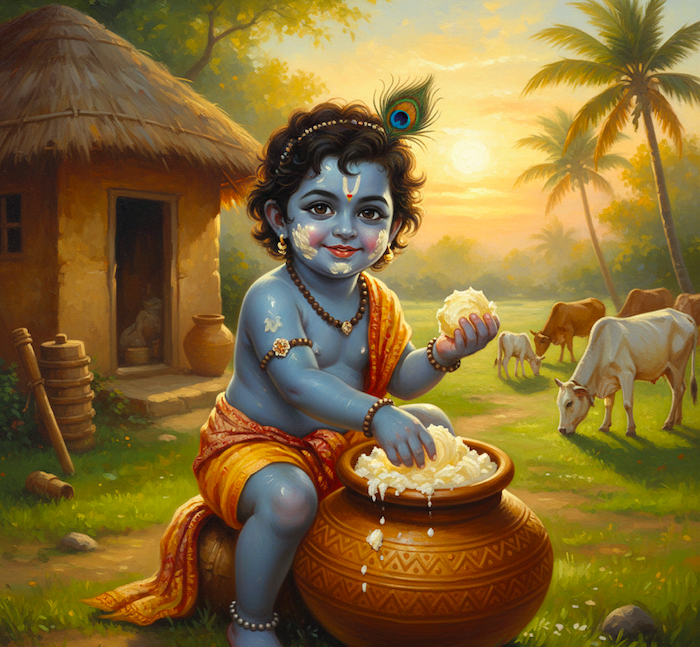
In a village, people kept butter in clay pots. They worked hard to make it from milk.
Young Krishna loved butter. He also loved games with his friends. Together, they watched where the pots were hung.
One woman began hanging hers very high. “Now little hands cannot reach it,” she said.
But Krishna’s friends stood below the pot and looked up. They made a plan. In the playful world of the story, they helped Krishna climb high enough to reach it.
Soon, butter was on their fingers, their cheeks and the floor. Their quiet plan became a very noisy feast.
A woman arrived at the doorway.
“Krishna!”
The children stopped. Krishna looked at the broken pot, then at the butter in his hand.
Later, the women told Yashoda what had happened. She listened carefully before calling her son.
“Butter does not appear by magic in every home,” she told him. “Someone works to make it.”
Krishna lowered his eyes. There was still a white mark beside his mouth.
“You call me your butter thief,” he said with a small smile.
Yashoda tried not to smile back. She loved his playful nature. But love did not mean the broken pot no longer mattered.
“Being funny does not clean the floor,” she said gently.
Krishna helped clear the mess. He listened as the woman explained that she had saved some butter for her family’s meal.
The next time the friends wanted a treat, they asked. They were given a little butter to share after their work.
This simple retelling keeps the warmth and play of the old story. It also gives young readers room to think about the people who prepare their food.
Yashoda’s care was steady. She could laugh with her child and still help him understand another person’s feelings.
The lesson: Love and kindness can guide us when we make a mistake.
Think about it: What could Krishna and his friends do to put things right? A story about gods can include magical play. In everyday life, ask before taking food or climbing on things.
Earlier short Hindi version
हिंदी: कृष्ण और मक्खन
छोटे कृष्ण मक्खन चुराने के लिए गोकुल में कुख्यात थे। गोपियाँ अपने मक्खन के मटके छत से ऊँचे टाँग देती थीं।
एक दिन, कृष्ण और उनके दोस्तों ने लकड़ी के तख्तों और मटकों का ढेर लगाकर एक मानव पिरामिड बनाया। कृष्ण शीर्ष पर चढ़े, मटका तोड़ा,
और सबने मक्खन का आनंद लिया। जब यशोदा मैया ने उन्हें मुंह पर मक्खन लगा हुआ पाया, तो उन्होंने डाँटा। कृष्ण ने मासूमियत से कहा, "लेकिन माँ,
क्या तुमने मुझे 'माखन चोर' नहीं कहा? मैं तो बस अपने नाम को सच कर रहा था!" उनके चतुर तर्क और मनमोहक मुस्कान ने उनका गुस्सा पिघला दिया।
शिक्षा: प्यार और मासूमियत गुस्से को निशस्त्र कर सकती है। साथ ही, हमारे कार्य ही हमारे नाम को परिभाषित करते हैं।
Earlier short German version
Deutsch: Krishna und die Butter
Der kleine Krishna war in Gokul berüchtigt dafür, Butter zu stehlen. Die Gopis (Milchmädchen)
hängten ihre Buttertöpfe hoch an die Decke. Eines Tages stapelten Krishna und seine Freunde
Holzplanken und Töpfe zu einer menschlichen Pyramide. Krishna kletterte nach oben, zerbrach den Topf,
und alle genossen die Butter. Als Yashoda Maiya ihn mit Butterspuren im Gesicht fand, schimpfte sie ihn aus.
Krishna sagte unschuldig: "Aber Mutter, hast du mich nicht 'Makhan Chor' (Butterdieb) genannt? Ich habe nur meinem
Namen alle Ehre gemacht!" Seine schlaue Logik und sein charmantes Lächeln ließen ihren Zorn schmelzen.
Moral: Liebe und Unschuld können Zorn entwaffnen. Auch definieren unsere Taten unseren Namen.
3. Narasimha Protects Prahlada
English story
Prahlada was a young prince. His father, King Hiranyakashipu, wanted everyone to follow only his wishes.
The king was very powerful. Over time, he began to think that power meant no one could question him.
Prahlada loved Lord Vishnu. He prayed quietly and tried to be kind to others.
His father heard about the prayers and became angry.
“You must honour me instead,” he ordered.
Prahlada was frightened, but he did not answer with hate. He explained that his faith was important to him.
The king tried again and again to stop him. In the traditional story, Prahlada faced great dangers. Each time, he was protected.
One evening, the king called him into a large hall. The air was quiet, and the shadows were long.
“Where is your Vishnu now?” the king asked.
“He is everywhere,” Prahlada replied.
The king pointed to a pillar. “Even here?”
Prahlada nodded.
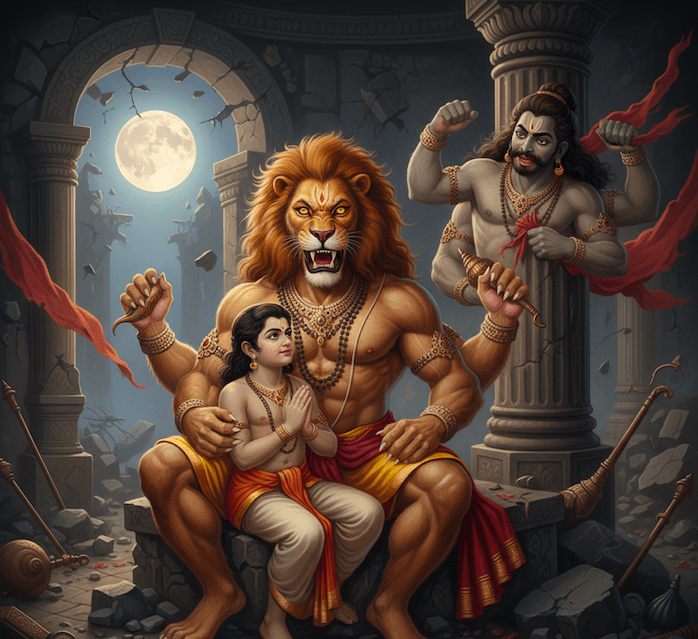
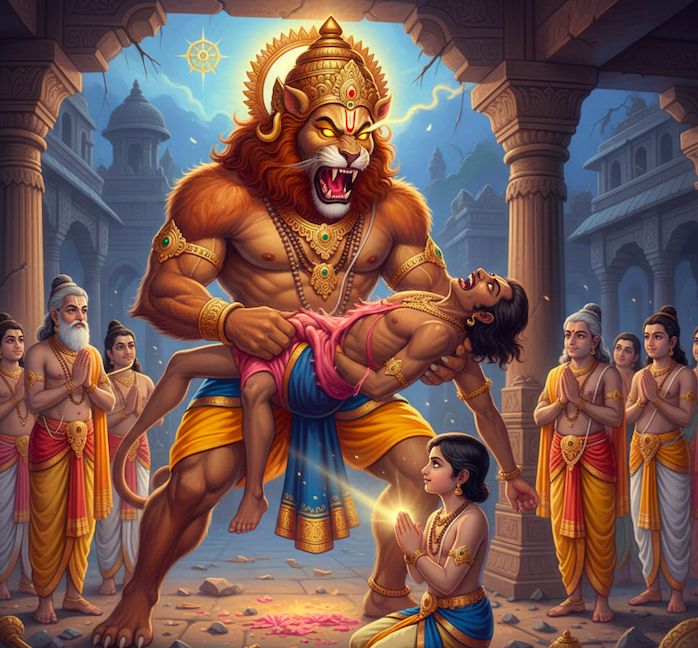
Hiranyakashipu struck the pillar. A great sound filled the hall. From it appeared Narasimha, a form of Vishnu with a human body and a lion’s face.
It was twilight, between day and night. Narasimha was neither only a man nor only an animal. In this way, the tale shows that the king’s belief in his own complete safety was mistaken.
Narasimha defeated the king and ended the danger to Prahlada. This children’s retelling leaves out the violent details.
When the hall was quiet, Prahlada did not ask for gold or power. He wished for peace.
People who had lived in fear could breathe more easily. The young prince’s strength had not been in shouting louder than his father. It had been in staying close to what he believed was right.
The story is a traditional account of faith and protection. It is not a promise that real danger can be faced without help.
The lesson: Power should protect people, not frighten them. Courage can be calm.
Think about it: Prahlada spoke without trying to hurt anyone. If a child feels unsafe in real life, which trusted adults or services could help them get protection?
Earlier short Hindi version
हिंदी: नरसिंह अवतार: प्रह्लाद की रक्षा
दैत्य राजा हिरण्यकश्यप को वरदान मिला था कि उसे न कोई मनुष्य या पशु, न घर के भीतर या बाहर,
न दिन या रात मार सकता है। वह अहंकारी हो गया और भगवान विष्णु की पूजा पर प्रतिबंध लगा दिया। उसका अपना पुत्र, प्रह्लाद,
एक भक्त विष्णु भक्त था। क्रोधित होकर, हिरण्यकश्यप ने प्रह्लाद को कई बार मारने की कोशिश की लेकिन असफल रहा।
अंत में, उसने महल के एक खंभे की ओर इशारा करके गरजा, "क्या तेरा विष्णु इस खंभे में है?" प्रह्लाद ने कहा, "वह हर जगह हैं।"
हिरण्यकश्यप ने खंभे पर प्रहार किया। गोधूलि (न दिन न रात) में, खंभे से (न अंदर न बाहर), भगवान नरसिंह प्रकट हुए—आधे मनुष्य, आधे सिंह (न मनुष्य न पशु)।
उन्होंने हिरण्यकश्यप को अपनी गोद में (न जमीन न आकाश) रखा और उसे पराजित किया, प्रह्लाद की रक्षा की।
शिक्षा: सच्ची भक्ति अजेय है। भगवान भक्तों की सबसे अप्रत्याशित तरीकों से रक्षा करते हैं, दिव्य न्याय की स्थापना करते हुए।
Earlier short German version
Deutsch: Narasimha-Avatara: Der Schutz Prahladas
Der Dämonenkönig Hiranyakashipu hatte einen Segen, dass er weder von Mensch noch Tier,
weder drinnen noch draußen, weder bei Tag noch bei Nacht getötet werden konnte.
Er wurde arrogant und verbot die Verehrung von Lord Vishnu. Sein eigener Sohn, Prahlada, war ein hingebungsvoller
Vishnu-Anhänger. Wütend versuchte Hiranyakashipu mehrmals, Prahlada zu töten, scheiterte aber. Schließlich zeigte er
auf eine Palastsäule und brüllte: "Ist dein Vishnu in dieser Säule?" Prahlada sagte: "Er ist überall." Hiranyakashipu schlug auf
die Säule. In der Dämmerung (weder Tag noch Nacht) trat aus der Säule (weder drinnen noch draußen) Lord Narasimha
hervor – halb Mensch, halb Löwe (weder Mensch noch Tier). Er setzte Hiranyakashipu auf seinen Schoß
(weder Boden noch Himmel) und besiegte ihn, wobei er Prahlada beschützte.
Moral: Wahre Hingabe ist unbesiegbar. Gott beschützt seine Anhänger auf die unerwartetsten Weisen
und wahrt dabei die göttliche Gerechtigkeit.
4. Ganesha and the Broken Tusk
English story
Vyasa had a long story to tell. It was full of families, difficult choices and important questions. He wanted someone to write it down.
He asked Ganesha for help.
“I will write,” Ganesha said, “but you must keep telling the story.”
Vyasa thought for a moment. “Then you must understand each line before you write it.”
They agreed. Each had a part to do. Vyasa would speak carefully. Ganesha would listen and understand.
They found a quiet place and began.
Page after page filled with words. Sometimes a line was simple. Sometimes its meaning needed thought. Ganesha did not rush past those parts.
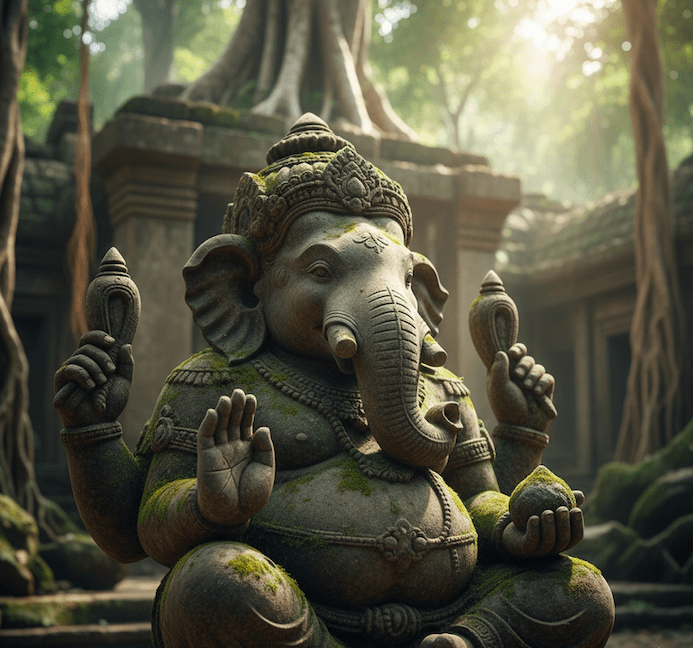
As he worked, his pen broke.
For a moment, the writing stopped. The long story was still being told. Ganesha needed another way to continue.
In this traditional account, he used one of his tusks as a pen. A tusk is one of an elephant’s long teeth. This is one story connected with Ganesha’s name Ekadanta, meaning one-tusked.
Vyasa saw how seriously Ganesha took their work. He also kept his own promise. He chose his words with care rather than speaking only to fill the quiet.
Their task needed more than one person’s talent. It needed listening, patience and trust.
When a difficult part came, both stayed with it. They did not treat understanding as less important than finishing quickly.
The great work they recorded was the Mahabharata.
For a young reader, the useful idea is not the magical act with the tusk. It is the care both put into a shared task.
A broken pencil in real life does not need a painful answer. You can stop, ask for a new tool and tell your partner what happened.
The story invites us to respect learning and the effort behind the books we read.
The lesson: Listen carefully, understand your work and take shared promises seriously.
Think about it: Vyasa and Ganesha made a clear plan before starting. What could you agree with a classmate before working together? What safe plan could help if your tools stop working?
Earlier short Hindi version
हिंदी: गणेश का टूटा दांत
महान ऋषि व्यास महाभारत की रचना करना चाहते थे लेकिन उन्हें एक लेखक की आवश्यकता थी।
भगवान गणेश ने इसे लिखने की सहमति दी, इस शर्त पर कि व्यास बिना रुके सुनाएँ। व्यास सहमत हो गए लेकिन
अपनी शर्त जोड़ी: गणेश को लिखने से पहले प्रत्येक श्लोक को समझना होगा। जैसे ही गणेश लिख रहे थे, उनकी नरकट की कलम टूट गई।
रुकने न देने के अपने वचन को निभाने के लिए, गणेश ने अपना एक दांत तोड़ा और उसे कलम की तरह इस्तेमाल करके लिखना जारी रखा।
इसीलिए गणेश को 'एकदंत' (एक दांत वाला) भी कहा जाता है। इस प्रकार महाभारत पूरी हुई, जो गणेश की बुद्धिमत्ता और प्रतिबद्धता का प्रमाण है।
शिक्षा: ज्ञान की प्राप्ति और अपने वचन को निभाने के लिए कोई भी त्याग बहुत बड़ा नहीं है।
Earlier short German version
Deutsch: Ganeshas gebrochener Stoßzahn
Der große Weise Vyasa wollte das Mahabharata verfassen, brauchte aber einen Schreiber.
Lord Ganesha erklärte sich bereit, es niederzuschreiben, unter der Bedingung,
dass Vyasa ohne Pause vorträgt. Vyasa stimmte zu, fügte aber seine eigene Bedingung hinzu:
Ganesha muss jeden Vers verstehen, bevor er ihn schreibt. Als Ganesha schrieb, brach sein Schilfrohrstift.
Um sein Versprechen, nicht aufzuhören, zu halten, brach Ganesha einen seiner eigenen Stoßzähne
ab und benutzte ihn als Stift, um weiterzuschreiben. Deshalb wird Ganesha auch 'Ekadanta' (der Einzahnige)
genannt. So wurde das Mahabharata vollendet, ein Zeugnis von Ganeshas Weisheit und Hingabe.
Moral: Kein Opfer ist zu groß für das Streben nach Wissen und das Halten des gegebenen Wortes.
5. Krishna and Kaliya

English story
People living beside the Yamuna depended on the river. It gave water to their fields and animals.
Then the water became dangerous. In the traditional tale, a powerful serpent named Kaliya lived there. His poison harmed the river.
Cows could not drink safely. Families stayed away from places where they once rested and played.
Young Krishna saw their fear. He wanted the river to be safe again.
He went to the bank. His friends called after him. The water moved darkly below.
In the magical story, Krishna entered the river and faced Kaliya. The serpent rose with many hoods. Water shook around them.
The struggle was long. People gathered on the bank, worried for Krishna.
Then they saw him standing above Kaliya’s hoods. He moved with calm strength. The serpent could no longer harm him.
Krishna could have answered danger only with more anger. Instead, he gave Kaliya a choice.
“Leave this river,” he said. “The people and animals need clean water.”
Kaliya’s family asked for mercy. Krishna listened. He allowed the serpent to leave and find another home away from the Yamuna.
Slowly, peace returned to the riverbank. People could think about their fields and animals again.
Krishna’s friends were glad to see him safe. The story celebrates his divine strength, not an ordinary child’s ability to fight a dangerous animal.
For readers, its lesson can also begin with something small. Water is shared. What happens to it can affect a whole community.
We can care for a river without stepping into danger. We can keep rubbish away from it and ask adults for help when water seems unsafe.
The villagers’ joy was not about winning a contest. It was about being able to live beside the water again.
The lesson: Real strength can protect others and leave room for mercy.
Think about it: Why was a safe river important to so many people? This is a religious story with magical events. In real life, never enter dangerous water or approach a snake to copy it.
Earlier short Hindi version
हिंदी: कृष्ण और कालिया नाग
यमुना नदी में कालिया नामक एक विषैला सर्प रहता था, जिसका जहर नदी को विषैला बना देता था। सभी डरे हुए थे।
युवा कृष्ण ने दुख देखकर नदी में छलांग लगा दी। एक भयंकर युद्ध छिड़ गया। कृष्ण ने कालिया के कई फनों पर नृत्य किया,
उसे अपने दिव्य भार से वश में किया। कालिया की पत्नियों ने दया की प्रार्थना की। कृष्ण ने कालिया के प्राण इस शर्त पर बख्शे कि वह
यमुना को हमेशा के लिए छोड़कर समुद्र में चला जाए। कृष्ण ने तब कालिया के फनों पर एक दिव्य नृत्य किया, अपने पदचिह्नों को आशीर्वाद
के रूप में छोड़ा, और जल को शुद्ध किया।
शिक्षा: साहस और दिव्य करुणा सबसे विषैली बुराई पर भी विजय पा सकती है,
संतुलन और पवित्रता बहाल कर सकती है।
Earlier short German version
Deutsch: Krishna und die Kaliya-Schlange
Im Yamuna-Fluss lebte Kaliya, eine giftige Schlange, deren Gift den Fluss vergiftete.
Alle hatten Angst. Der junge Krishna sprang, nachdem er das Leiden gesehen hatte, in den Fluss.
Ein heftiger Kampf entbrannte. Krishna tanzte auf Kaliyas vielen Hauben und unterwarf ihn mit seinem göttlichen Gewicht.
Kaliyas Frauen beteten um Gnade. Krishna verschonte Kaliyas Leben unter der Bedingung, dass er Yamuna für immer verlässt
und in den Ozean geht. Dann führte Krishna einen göttlichen Tanz auf Kaliyas Hauben auf, hinterließ seine
Fußabdrücke als Segen und reinigte das Wasser.
Moral: Mut und göttliches Mitgefühl können sogar das giftigste Böse bezwingen
und Gleichgewicht und Reinheit wiederherstellen.
6. Ganesha and the Moon
English story
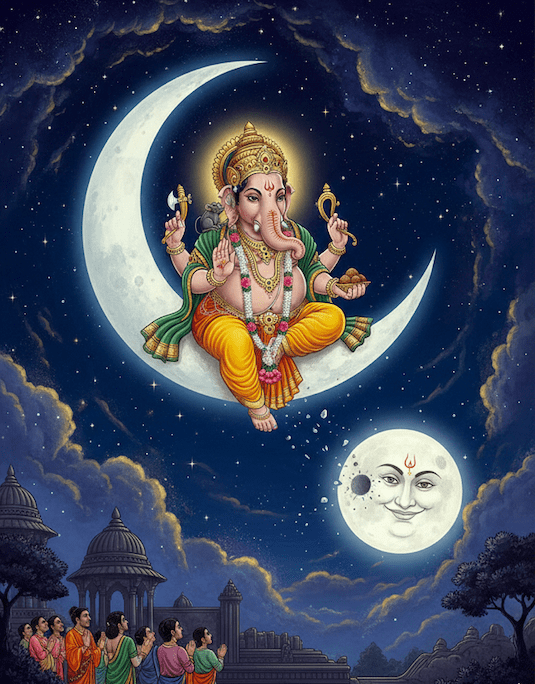
After a feast, Ganesha travelled home beneath a bright moon. The road was quiet, and his small mouse moved carefully.
Suddenly, a snake crossed their path. The mouse was startled, and Ganesha fell.
The moon saw what happened and laughed.
Ganesha was already upset by the fall. Being laughed at made him feel worse.
He looked up at the sky. “You laugh because someone had a difficult moment,” he said.
In the traditional story, Ganesha’s anger brought a curse upon the moon. The bright light began to disappear.
At first, the moon had thought it was only a joke. Now the whole night seemed different.
Travellers could not see as well. The sky lost something people had trusted to be there.
The moon understood that the joke had not been kind. He asked Ganesha to forgive him.
“I saw your fall,” he said, “but I did not think about how you felt.”
Ganesha listened. His anger began to soften. He could see that the moon was truly sorry.
In this retelling, the curse was changed. The moon would not stay dark forever. Its light would grow and become smaller through the month.
The story is told in different ways in different families and traditions. Its changing moon is part of the tale, not a science lesson about the sky.
For a child listening, the important moment may be very familiar: someone falls, drops something or says a word wrongly, and others laugh.
The moon could have asked whether Ganesha was hurt. He could have offered care instead of making the moment harder.
Ganesha, too, found a way to move beyond anger. Forgiveness did not make the joke kind, but it allowed a better ending.
That night, the road was quiet again. The lesson remained under the returning light.
The lesson: Do not laugh at someone’s pain or embarrassment. A real apology shows understanding.
Think about it: What could you say if a friend falls or makes a mistake? If you laugh without thinking, how can you put things right without making excuses?
Earlier short Hindi version
हिंदी: गणेश और चंद्रमा (संकष्टी चतुर्थी की कहानी)
एक भव्य भोज के बाद, भगवान गणेश अपने चूहे पर सवार होकर घर जा रहे थे।
अचानक, एक साँप दिखाई दिया, जिससे चूहा डर गया। गणेश गिर गए, और उनका बड़ा पेट फट गया, मिठाइयाँ बिखर गईं।
गणेश ने शांति से मिठाइयाँ इकट्ठी की, उन्हें वापस अपने पेट में रखा, और साँप को बेल्ट की तरह इस्तेमाल किया। चंद्रमा, चंद्र ने यह देखा और
खिलखिलाकर हँसा। मजाक पर नाराज होकर, गणेश ने चंद्रमा को गायब होने का श्राप दिया। चंद्रमा ने क्षमा माँगी। गणेश ने श्राप को नरम कर दिया: चंद्रमा
हर महीने घटेगा और बढ़ेगा। उन्होंने यह भी घोषित किया कि जो कोई गणेश चतुर्थी के दिन चंद्रमा को देखेगा, उस पर झूठे आरोप लगेंगे। इसीलिए भक्त उस रात
चंद्रमा के दर्शन से बचते हैं।
शिक्षा: दूसरों की विपत्ति का मजाक न उड़ाओ। साथ ही, दिव्य श्राप में भी करुणा और मोक्ष का मार्ग हो सकता है।
Earlier short German version
Deutsch: Ganesha und der Mond (Die Geschichte von Sankashti Chaturthi)
Nach einem großen Festmahl ritt Lord Ganesha auf seiner Maus nach Hause.
Plötzlich erschien eine Schlange und erschreckte die Maus. Ganesha fiel und sein großer Bauch platzte auf,
sodass Süßigkeiten verstreut wurden. Ganesha sammelte gelassen die Süßigkeiten, steckte sie zurück in seinen Bauch
und benutzte die Schlange als Gürtel. Der Mond, Chandra, sah dies und lachte herzlich. Verärgert über den Spott verfluchte
Ganesha den Mond, zu verschwinden. Der Mond flehte um Vergebung. Ganesha milderte den Fluch:
Der Mond würde jeden Monat ab- und zunehmen. Er erklärte auch, dass jeder, der am Tag von Ganesha Chaturthi
den Mond ansehe, mit falschen Anschuldigungen konfrontiert werde. Deshalb vermeiden Anhänger an dieser Nacht,
den Mond zu erblicken.
Moral: Spotte nicht über das Unglück anderer. Auch Flüche des Göttlichen
können Mitgefühl und einen Weg zur Erlösung enthalten.
7. Krishna Lifts Govardhan Hill
English story
The people of Vrindavan worked with fields, cows and the land around Govardhan Hill. They depended on grass, water and shelter.
One day, they prepared a great offering to Indra, the god of rain.
Young Krishna asked a question. “Should we also thank the land that feeds our animals?”
The villagers stopped to think. They knew the paths of the hill. They gathered grass there and rested in its shade.
They chose to give thanks to Govardhan and the care of their cows.
In the traditional story, Indra became angry. Dark clouds gathered. Rain began to fall harder than anyone expected.
The paths filled with water. People carried children and tried to move their animals. The place that had felt like home now seemed unsafe.
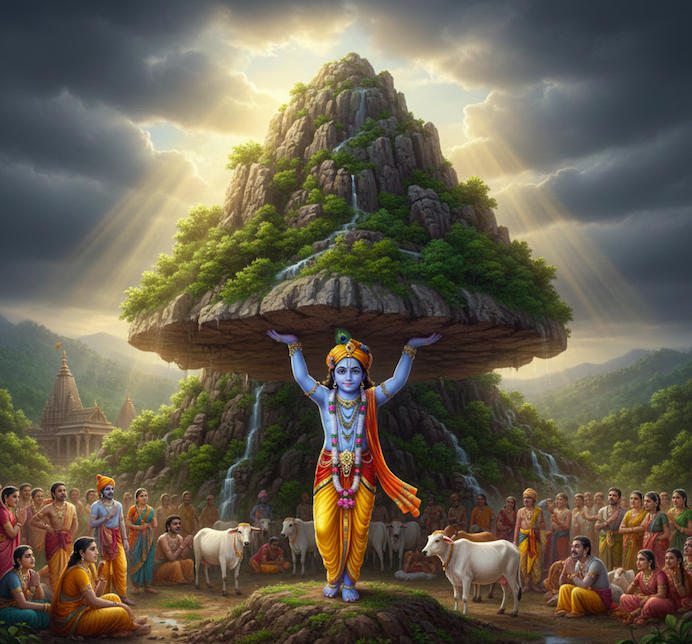
Krishna saw the danger. With divine strength, he lifted Govardhan Hill. It became a great shelter above the villagers.
People and cows gathered beneath it. There was room for the weak, the young and the old.
For seven days and nights, the storm continued. Krishna held the hill while everyone waited together.
The villagers shared what they had. They checked on neighbours and kept the animals close. No one had to face the storm alone.
At last, Indra saw that anger and pride had led him wrongly. He stopped the rain and asked forgiveness.
When the sky cleared, people stepped out slowly. Their land was wet, but the terrible storm was over.
Krishna lowered the hill. The villagers looked at the place that had sheltered them and understood its value in a new way.
This is a story of divine protection. Its everyday lesson does not need anyone to lift a hill. We can notice what nature gives us and help each other through hard times.
The lesson: Care for nature and use your strength to protect others.
Think about it: What did the village need from the land? In a real storm, follow safety advice and go to a safe shelter. How can a family prepare together before bad weather arrives?
Earlier short Hindi version
हिंदी: कृष्ण गोवर्धन पर्वत उठाते हैं
वृंदावन में, लोगों ने अच्छी मानसून सुनिश्चित करने के लिए भगवान इंद्र (वर्षा के देवता) के लिए एक भव्य भेंट तैयार की।
युवा कृष्ण ने इस पर सवाल उठाया। "हम किसान हैं; हमें गोवर्धन पर्वत की पूजा करनी चाहिए, जो हमें गायों के लिए घास देता है,
और हमारी गायें हमें सब कुछ देती हैं।" मान जाने पर, ग्रामीणों ने गोवर्धन को अपनी प्रार्थनाएँ अर्पित कीं। क्रोधित इंद्र ने वृंदावन को बाढ़ने
के लिए मूसलाधार बारिश भेजी। सभी की रक्षा के लिए, कृष्ण ने पूरे गोवर्धन पर्वत को अपनी छोटी उंगली पर एक छाते की तरह उठा लिया।
सात दिन और रात तक, लोग और गायें उसके नीचे आश्रय लेते रहे, सुरक्षित रहे। नम्र होकर, इंद्र ने कृष्ण की दिव्यता को पहचानते हुए क्षमा माँगी।
शिक्षा: प्रकृति का सम्मान और रक्षा करो, जो हमें पोषित करती है। सच्ची शक्ति कमजोरों की रक्षा करने में निहित है।
Earlier short German version
Deutsch: Krishna hebt den Govardhan-Hügel
In Vrindavan bereiteten die Menschen ein großes Opfer für Lord
Indra (Gott des Regens) vor, um einen guten Monsun zu gewährleisten.
Der junge Krishna stellte dies in Frage. "Wir sind Bauern; wir sollten den Govardhan-Hügel verehren,
der uns Gras für die Kühe gibt, und unsere Kühe geben uns alles." Überzeugt brachten die
Dorfbewohner ihre Gebete dem Govardhan dar. Ein wütender Indra schickte sintflutartige Regenfälle,
um Vrindavan zu überfluten. Um alle zu schützen, hob Krishna den gesamten Govardhan-Hügel auf seinem
kleinen Finger wie einen Schirm. Sieben Tage und Nächte lang fanden die Menschen und Kühe unversehrt
Schutz darunter. Demütig entschuldigte sich Indra und erkannte Krishnas Göttlichkeit an.
Moral: Achte und schütze die Natur, die uns erhält. Wahre Stärke liegt im Schutz der Schwachen.
8. Prahlada Learns to Lead with Kindness
English story
After the danger in his father’s palace ended, Prahlada faced a new question. What kind of ruler would he become?
He had seen people obey because they were afraid. Guards had lowered their eyes when his father entered. Servants had hidden small mistakes.
Prahlada did not want the same life for his people.
Some boys who knew him asked, “Will you punish everyone who disagreed with you?”
“No,” he replied. “Fear has already caused enough harm.”
They found this difficult to understand. In their homes, strength often meant making someone else feel small.
Prahlada spoke about his faith in Vishnu. He believed it should guide his own actions towards kindness and fairness.
“If I speak about goodness,” he said, “I must also try to do good.”
One morning, two people came with a quarrel over a field. Each wanted him to listen only to their side.
Prahlada asked both to speak. Then he asked questions. He would not decide simply because one person wore better clothes.
Another day, a servant admitted breaking a cup. The servant expected anger.
“Was anyone hurt?” Prahlada asked first.
The servant shook his head.
“Then let us clear the broken pieces safely.”
Small moments like these slowly changed the palace. People learned that telling the truth did not always bring danger. They could ask for help before a problem became worse.
Not every day was easy. Prahlada still had to make hard choices. Fairness needed more than a kind speech.
He listened, learned and tried again when he was wrong.
This gentle retelling follows the lesson of Prahlada’s faith into daily life. The great victory was not only that fear had ended once. It was that he chose not to build a new life on fear.
The lesson: Our beliefs should be seen in the care and fairness of our actions.
Think about it: Why did the servant expect anger? How can a teacher, parent or team leader make it easier for someone to admit a mistake and ask for help?
Earlier short Hindi version
हिंदी: नरसिंह और भक्ति की शक्ति (प्रह्लाद की शिक्षाएँ)
अपने पिता की हार के बाद भी, प्रह्लाद महल में ही रहा, अब राजा के रूप में। उसके सहपाठी, राक्षसों के पुत्र, उसका मजाक उड़ाते थे। "तेरे पिता तेरी भक्ति के कारण मर गए!" उन्होंने कहा। प्रह्लाद ने शांति से उत्तर दिया, "मेरी भक्ति दोषी नहीं है। यह वह अहंकार है जो ईश्वर का विरोध करता है, जो पतन की ओर ले जाता है। भगवान हर चीज में हैं—यहाँ तक कि इस खंभे में, इस दीवार में, और तुम्हारे भीतर भी।" उनके शब्दों ने उनमें से कुछ में संदेह और बाद में विश्वास के बीज बोए। प्रह्लाद ने निष्पक्षता और भक्ति के साथ शासन किया, यह दिखाते हुए कि सच्ची शक्ति भय से नहीं, बल्कि धर्म से आती है।
शिक्षा: अटल विश्वास और धार्मिकता दुश्मनों को बदल सकती है और शांति और न्याय के साथ एक राज्य का नेतृत्व कर सकती है।
Earlier short German version
Deutsch: Narasimha und die Kraft der Hingabe (Prahladas Lehren)
Selbst nach der Niederlage seines Vaters blieb Prahlada im Palast, nun als König.
Seine Klassenkameraden, die Söhne der Dämonen, verspotteten ihn.
"Dein Vater ist wegen deiner Hingabe tot!", sagten sie. Prahlada antwortete gelassen: "Meine Hingabe ist nicht schuld.
Es ist der Hochmut, der sich Gott widersetzt, der zum Untergang führt. Gott ist in allem – sogar in dieser Säule,
dieser Wand und in dir." Seine Worte säten Zweifel und später Glauben in einige von ihnen. Prahlada regierte
mit Fairness und Hingabe und zeigte, dass wahre Macht aus Rechtschaffenheit kommt, nicht aus Angst.
Moral: Unerschütterlicher Glaube und Rechtschaffenheit können Feinde verwandeln und ein Königreich in
Frieden und Gerechtigkeit führen.
9. Ganesha and Kubera’s Feast
English story
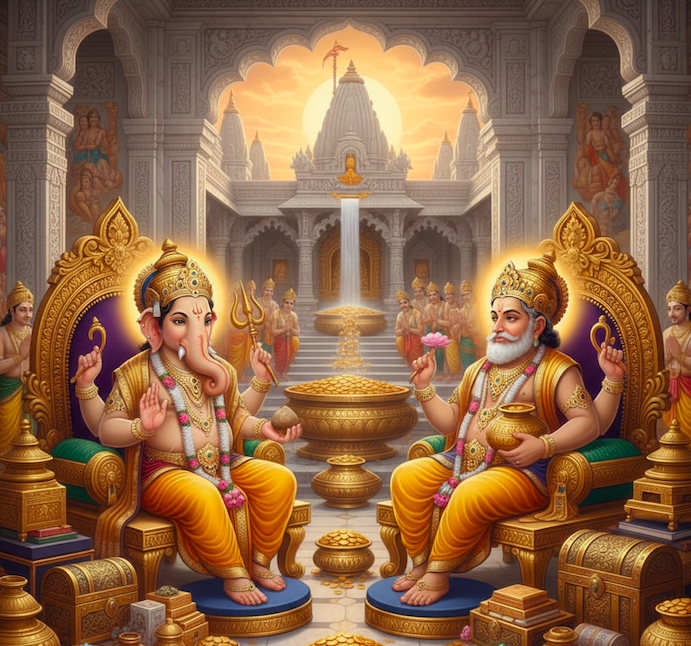
Kubera had great wealth. His rooms shone with gold, and his tables held fine dishes.
He invited Shiva and Parvati to a feast. But his invitation had another purpose. He wanted them to see how rich he was.
Shiva sent Ganesha instead.
Kubera welcomed his young guest with a proud wave. “You will not find a meal like this anywhere.”
Servants brought bowls of rice, vegetables and sweets. Ganesha ate. More plates arrived, and he ate those too.
Kubera laughed at first. Then he began to worry.
The kitchens grew busy. Cooks called for more food. The proud host walked from room to room, asking how much remained.
Ganesha was still hungry.
In this playful traditional tale, his hunger became so great that the palace itself seemed in danger. Kubera could no longer hide behind his gold.
He hurried to Shiva. “I thought I could provide anything,” he said. “Now I do not know what to do.”
For the first time that day, he was asking for help instead of showing off.
Shiva gave him a small, simple offering of food. He told Kubera to give it with love rather than pride.
Kubera returned and stood before Ganesha. His voice was quieter now.
“I wanted everyone to admire me,” he admitted. “I forgot to think about my guest.”
He offered the small amount with care. Ganesha ate it, and at last his hunger was satisfied.
The great rooms were still bright. The dishes were still fine. But Kubera understood that none of them could replace a kind welcome.
At his next feast, he asked whether his guests were comfortable. He sat with them instead of counting the dishes.
His home had not become less rich. It had become warmer.
The lesson: A gift given with care can mean more than a large display of wealth.
Think about it: Have you enjoyed a simple meal because someone made you feel welcome? What can a host do to show care without spending a lot of money?
Earlier short Hindi version
हिंदी: गणेश और कुबेर का अहंकार
धन के देवता, कुबेर ने शिव और पार्वती को अपने धन का प्रदर्शन करने के लिए एक भव्य भोज पर आमंत्रित किया। शिव ने इसके बजाय युवा गणेश को भेजा।
भोज में, गणेश ने अविश्वसनीय गति से खाना शुरू कर दिया, सारा भोजन खा गए। अभी भी भूखे, उन्होंने सजावट,
फर्नीचर और यहाँ तक कि महल की दीवारें भी खानी शुरू कर दीं! एक भयभीत कुबेर मदद के लिए शिव के पास दौड़ा। शिव ने उन्हें
एक मुट्ठी भुने चावल दिए। जब गणेश ने अपने पिता के हाथों से वह विनम्र भेंट खाई, तो उसकी भूख अंततः संतुष्ट हो गई। शिव ने समझाया,
"सच्ची संतुष्टि मात्रा से नहीं, बल्कि उस प्यार और विनम्रता से आती है जिसके साथ भोजन चढ़ाया जाता है।"
शिक्षा: प्यार से दी गई विनम्रता और साधारण भेंट, गर्व के भव्य प्रदर्शनों से अधिक संतोषजनक होती हैं।
Earlier short German version
Deutsch: Ganesha und Kuberas Stolz
Der Gott des Reichtums, Kubera, lud Shiva und Parvati zu einem üppigen Festmahl ein,
um seinen Reichtum zur Schau zu stellen. Shiva schickte stattdessen den jungen Ganesha. Beim
Festmahl begann Ganesha mit unglaublicher Geschwindigkeit zu essen und verzehrte alle Speisen. Immer noch
hungrig begann er, die Dekorationen, die Möbel und sogar die Palastwände zu essen! Ein verängstigter Kubera
eilte zu Shiva um Hilfe. Shiva gab ihm eine Handvoll gerösteten Reis. Als Ganesha diese bescheidene Gabe aus
den Händen seines Vaters aß, war sein Hunger endlich gestillt. Shiva erklärte: "Wahre Zufriedenheit kommt nicht von
der Menge, sondern von der Liebe und Demut, mit der das Essen angeboten wird."
Moral: Demut und einfache Gaben, die mit Liebe gegeben werden, sind befriedigender
als prunkvolle Zurschaustellungen des Stolzes.
10. Krishna and Sudama
English story
Sudama had known Krishna when they were children. They had learned and played together. As adults, their lives became very different.
Krishna lived in a great palace. Sudama’s family often struggled to find enough food.
One day, Sudama’s wife suggested that he visit his old friend.
Sudama felt unsure. He did not want friendship to look like a request for money. He also had no grand gift to carry.
His wife wrapped a little flattened rice in a cloth. “Take what we can give with love,” she said.
The journey was long. At the palace gate, Sudama looked at his worn clothes. He almost turned away.
Then Krishna saw him.
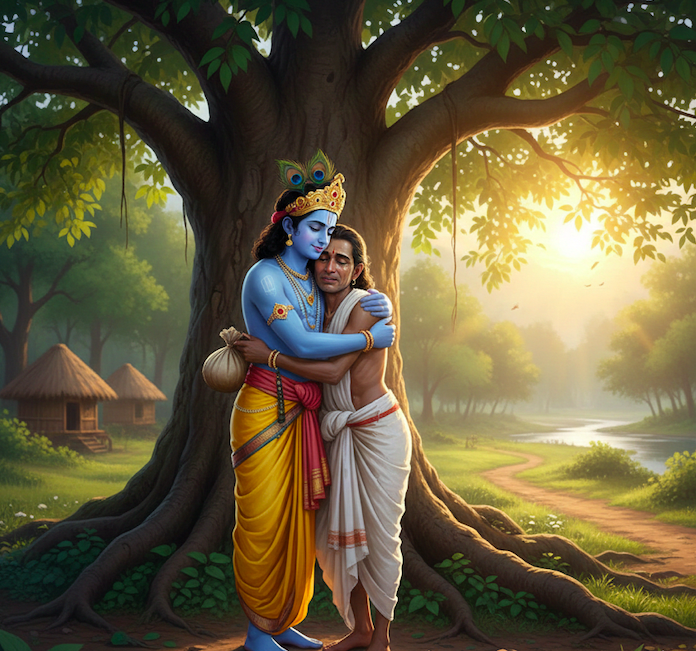
He hurried forward and welcomed his friend warmly. He did not wait for a new coat or a fine introduction.
Inside, he gave Sudama a comfortable seat. They spoke about their days together. The great palace began to feel less strange.
Sudama tried to hide the small bundle. Krishna noticed it and asked what he had brought.
“It is only a little rice,” Sudama said.
Krishna received it with joy. To him, the gift carried the care of a family that had very little to spare.
The friends talked for a long time. Sudama forgot the speech he had prepared. He did not ask for riches.
When he returned home, he found that his family’s needs had been met. In the traditional story, Krishna had given help without making his friend beg for it.
Sudama was grateful, but he also remembered something from before the gift. Krishna had welcomed him when he still looked poor.
The friendship had not begun again because of money. It had been there when the palace doors opened.
The lesson: A true friend values the person, not their clothes, money or gift.
Think about it: Why did Sudama feel shy about his small bundle? How could you welcome a friend who has less money or cannot bring something to share?
Earlier short Hindi version
हिंदी: कृष्ण और सुदामा: सच्ची मित्रता की शक्ति
सुदामा एक गरीब ब्राह्मण और भगवान कृष्ण के बचपन के दोस्त थे। जरूरत के समय, उनकी पत्नी ने उन्हें कृष्ण, जो अब एक राजा थे,
से मदद मांगने के लिए प्रेरित किया। कोई उपहार न होने पर शर्मिंदा, सुदामा चावल के चिउड़े (पोहा) की एक छोटी पोटली ले गए, उनकी एकमात्र भेंट।
कृष्ण के भव्य महल में, गार्डों ने जर्जर सुदामा को रोकने की कोशिश की। लेकिन कृष्ण ने दूर से उन्हें देखा, उन्हें गले लगाने के लिए दौड़े, उनके पैर धोए,
और उनके साथ भाई जैसा व्यवहार किया। अभिभूत, सुदामा अपना विनम्र उपहार भी पेश नहीं कर सके। कृष्ण ने खुद उसे ढूंढा और खुशी से पोहा खाया।
जब सुदामा घर लौटे, तो उन्होंने अपनी झोपड़ी को एक महल में बदला हुआ पाया, सभी धन-संपत्ति के साथ। कृष्ण ने उनकी जरूरत बिना पूछे ही पूरी कर दी थी।
शिक्षा: सच्ची मित्रता धन और पद से अधिक प्यार और सादगी को महत्व देती है। भगवान ईमानदार भक्ति और निस्वार्थ प्रेम को पुरस्कृत करते हैं।
Earlier short German version
Deutsch: Krishna und Sudama: Die Kraft wahrer Freundschaft
Sudama war ein armer Brahmane und Jugendfreund von Lord Krishna. In seiner Not drängte ihn seine Frau,
Hilfe bei Krishna zu suchen, der nun König war. Beschämt, kein Geschenk zu haben, nahm Sudama einen kleinen
Beutel mit Flattenreis (Poha), ihr einziges Opfer. In Krishnas prächtigem Palast versuchten die Wachen, den schäbigen
Sudama aufzuhalten. Aber Krishna, der ihn von Weitem sah, rannte, um ihn zu umarmen, wusch ihm die Füße und
behandelte ihn wie einen Bruder. Überwältigt konnte Sudama nicht einmal sein bescheidenes Geschenk überreichen.
Krishna selbst fand den Poha und aß ihn freudig. Als Sudama nach Hause zurückkehrte, fand er seine Hütte in einen
Palast verwandelt vor, mit allen Reichtümern. Krishna hatte sein Bedürfnis erfüllt, ohne dass er danach gefragt hatte.
Moral: Wahre Freundschaft schätzt Liebe und Einfachheit mehr als Reichtum und Status. Gott belohnt aufrichtige
Hingabe und selbstlose Liebe.
11. How Ganesha Received an Elephant’s Head
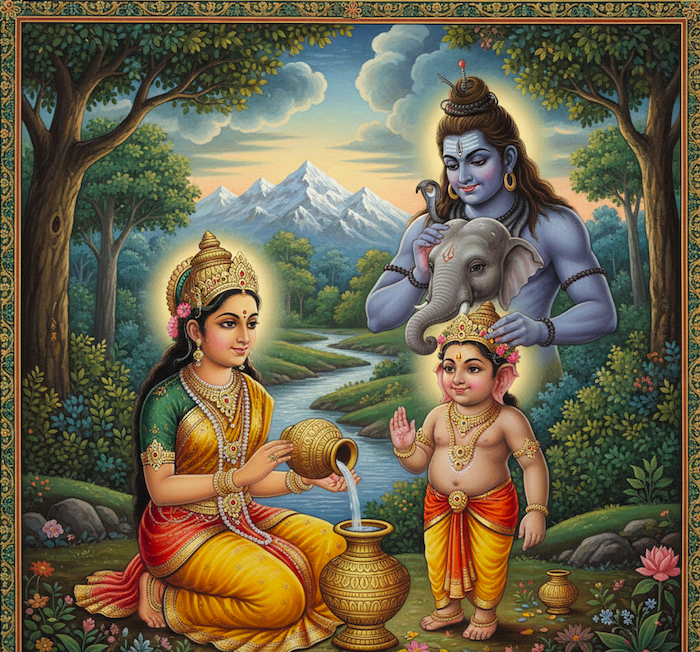
English story
Parvati wanted a quiet place to bathe. She needed someone she could trust to guard the entrance.
In this traditional story, she shaped a boy from the paste she used on her skin and gave him life. She called him her son.
“Please wait by the door,” she told him. “Do not let anyone enter while I am inside.”
The boy took his task seriously. He stood at the entrance and watched the path.
Soon Shiva returned. He did not yet know about Parvati’s new son.
The boy stopped him. “My mother asked for privacy.”
Shiva was surprised. Each believed the other should understand. Neither had the full story.
Their disagreement grew. In the old account, a terrible fight followed, and the boy lost his life. This retelling leaves out the violent details.
When Parvati came outside, she was filled with grief. She explained who the child was and why he had guarded the door.
Shiva understood the terrible mistake. He promised to bring the boy back.
Through divine power, the child returned to life with an elephant’s head. Parvati held her son close. The fear and grief of the moment gave way to joy.
Shiva welcomed him and gave him a special place. He became known as Ganesha and Ganapati. Many people honour him before beginning an important task.
The tale also connects him with helping people face difficulties. Families tell these events in different ways, with different details.
For a young reader, the story can open a gentle conversation about listening. The boy was following an instruction. Shiva did not know where that instruction came from.
In everyday life, a misunderstanding needs questions, patience and safe help, not force.
The story ends with the child welcomed as part of the family. His new appearance does not take away his place in his mother’s heart.
The lesson: Listen before judging. Care and belonging are deeper than appearance.
Think about it: This is a religious story, not a model for handling real disagreements. What questions could people ask when they do not understand each other’s actions?
Earlier short Hindi version
हिंदी संस्करण (Hindi Version)
भाग 1: गणेश का जन्म
एक दिन, जब देवी पार्वती कैलाश पर्वत पर अपने आवास में स्नान की तैयारी कर रही थीं,
तो उन्हें दरवाजे पर एक पहरेदार की आवश्यकता हुई। उन्होंने अपने ही शरीर से हल्दी का पेस्ट (उबटन) लिया और एक सुदृढ़, सुंदर बालक का रूप दिया।
उसमें प्राण फूँककर, उन्होंने उसे अपना पुत्र घोषित किया और आदेश दिया कि वह प्रवेश द्वार की रक्षा करे और किसी को भी अंदर न आने दे।
भाग 2: भाग्यशाली टकराव
कुछ ही देर बाद, भगवान शिव (पार्वती के पति) घर लौटे। वह युवा बालक, जो केवल अपनी माता के आदेश के प्रति वफादार था,
ने शिव का मार्ग रोक दिया। "आप अंदर नहीं जा सकते। मेरी माता ने एकांत माँगा है," उसने दृढ़ता से कहा। ब्रह्मांड के सर्वोच्च स्वामी शिव अचंभित रह गए।
उन्होंने समझाया कि वे कौन हैं, लेकिन बालक अटल रहा। बहस हुई, और शिव के सेवक (गण) बल प्रयोग करने लगे लेकिन
उस शक्तिशाली बालक द्वारा पराजित हुए।
इस अवज्ञा से क्रोधित होकर, शिव ने अपने क्रोध में युद्ध किया और अंततः अपने त्रिशूल से बालक का सिर धड़ से अलग कर दिया।
भाग 3: पार्वती का शोक और शिव का वादा
हलचल सुनकर, पार्वती बाहर आईं और अपने पुत्र को निर्जीव देखकर तिलमिला गईं। उनका दुःख ब्रह्मांड को शोक में ठंडा कर दिया।
उन्होंने समझाया कि वह बालक उनका पुत्र था, उन्हीं के सार से निर्मित। शिव, पश्चाताप से भर गए, और बालक को पुनर्जीवित करने का संकल्प लिया।
उन्होंने अपने गणों को आदेश दिया: "जाओ और पहले जीवित प्राणी का सिर लेकर आओ, जो उत्तर की ओर सिर करके सो रहा हो।"
भाग 4: हाथी का सिर
गणों ने खोज की और एक बुद्धिमान, परिपक्व हाथी को निर्धारित तरीके से सोता हुआ पाया।
वे उसका सिर लेकर शिव के पास आए। भगवान ने हाथी के सिर को बालक के धड़ पर रखा, उसमें प्राण फूँके और उसे पुनर्जीवित किया।
पार्वती अपने पुत्र को वापस पाकर अत्यंत प्रसन्न हुईं, लेकिन उसके नए रूप से दुखी भी हुईं।
शिव ने बालक को दिव्य दर्जा प्रदान किया, उसका नाम गणपति (गणों के स्वामी) रखा और
घोषणा की कि किसी भी कार्य को प्रारंभ करने से पहले उसकी पूजा की जाएगी।
भाग 5: विनायक / विघ्नेश्वर बनना
शिव ने उन्हें एक अनोखा वरदान भी दिया: विघ्न उत्पन्न करने और दूर करने की शक्ति। उन्होंने कहा,
"तुम विघ्नेश्वर बनोगे—विघ्नों के स्वामी। तुम्हारी अनुमति के बिना कोई भी कार्य, धार्मिक हो या सांसारिक, सफल नहीं होगा।
जो भक्ति से तुम्हारी पूजा करेंगे, उनके विघ्न दूर होंगे, लेकिन तुम अहंकारी और दुष्टों के मार्ग में विघ्न भी डाल सकते हो।"
इस प्रकार, हाथी के सिर वाले देवता वह प्रिय देवता बन गए जो विघ्नहर्ता (विघ्नों को दूर करने वाले) और विघ्नेश्वर (विघ्नों को स्थापित करने वाले) दोनों हैं,
जो सभी उद्यमों में विनम्रता और भक्ति सुनिश्चित करते हैं।
शिक्षा:
-
अटल कर्तव्य: गणेश हमें अपने दिए गए कार्य के प्रति निष्ठा और समर्पण का गुण सिखाते हैं।
-
रूपांतरण और स्वीकृति: हमारी सबसे बड़ी हानि हमारे सबसे बड़े रूपांतरण और दिव्य उद्देश्यों की ओर ले जा सकती है।
-
विनम्रता: सफलता के लिए दिव्य कृपा और विनम्रता आवश्यक है; अहंकार स्वयं अपने विघ्न पैदा करता है।
Earlier short German version
Deutsche Version (German Version)
Teil 1: Die Geburt Ganeshas
Eines Tages, als Göttin Parvati in ihrer Wohnstätte auf dem Berg Kailash ein Bad vorbereitete,
brauchte sie einen Wächter an ihrer Tür. Sie nahm die Kurkuma-Paste (Ubtan) von ihrem eigenen
Körper und formte sie zu einem starken, gutaussehenden Jungen. Sie hauchte ihm Leben ein, erklärte
ihn zu ihrem Sohn und wies ihn an, den Eingang zu bewachen und niemanden einzulassen.
Teil 2: Die schicksalhafte Konfrontation
Kurz darauf kehrte Lord Shiva, Parvatis Ehemann, nach Hause zurück. Der junge Junge, der
nur dem Befehl seiner Mutter treu war, versperrte Shiva den Weg. "Du kannst nicht eintreten. Meine
Mutter hat um Privatsphäre gebeten", sagte er fest. Shiva, der höchste Herr des Universums, war verblüfft.
Er erklärte, wer er war, aber der Junge blieb standhaft. Ein Streit entbrannte, und Shivas Begleiter (Ganas) versuchten,
gewaltsam einzudringen, wurden aber von dem mächtigen Jungen besiegt.
Empört über den Widerstand, kämpfte Shiva in seiner Wut und trennte schließlich mit seinem
Dreizack (Trishul) den Kopf des Jungen ab.
Teil 3: Parvatis Trauer und Shivas Versprechen
Als Parvati den Lärm hörte, kam sie heraus und war am Boden zerstört, als sie ihren Sohn leblos sah.
Ihr Kummer ließ das Universum vor Trauer erstarren. Sie erklärte, dass der Junge ihr Sohn war, geschaffen
aus ihrem eigenen Wesen. Shiva, von Reue erfüllt, gelobte, den Jungen wieder zum Leben zu erwecken.
Er wies seine Ganas an: "Geht und bringt den Kopf des ersten Lebewesens, das ihr mit dem Kopf nach Norden schlafend findet."
Teil 4: Der Kopf des Elefanten
Die Ganas suchten und fanden einen weisen, ausgewachsenen Elefanten, der auf die beschriebene Art schlief.
Sie brachten seinen Kopf zu Shiva. Der Lord setzte den Elefantenkopf auf den Körper des Jungen, hauchte ihm
Leben ein und erweckte ihn wieder zum Leben. Parvati war überglücklich, ihren Sohn zurückzuhaben,
aber auch traurig über seine neue Gestalt. Shiva segnete den Jungen mit göttlichem Status,
nannte ihn Ganapati (Herr der Ganas) und erklärte, dass er vor jedem Unterfangen zuerst verehrt werden solle.
Teil 5: Die Entstehung von Vigneshwara
Shiva gab ihm auch eine einzigartige Gabe: die Macht, Hindernisse (Vighnas) zu erschaffen und zu beseitigen.
Er sagte: "Du sollst Vigneshwara sein – der Herr der Hindernisse. Keine Aufgabe, heilig oder weltlich, soll ohne deine
Erlaubnis gelingen. Diejenigen, die dich mit Hingabe verehren, werden ihre Hindernisse beseitigt finden, aber du kannst
auch Hindernisse auf den Weg der Arroganten und Bösen legen."
So wurde der elefantenköpfige Gott zur geliebten Gottheit, die sowohl der Beseitiger von Hindernissen (Vighnaharta)
als auch der Erschaffer von Hindernissen (Vigneshwara) ist und so Demut und Hingabe in allen Unternehmungen sicherstellt.
Moral:
-
Unerschütterliche Pflicht: Ganesha lehrt uns die Tugend der Loyalität und Hingabe an unsere gegebene Aufgabe.
-
Verwandlung & Annahme: Unsere größten Verluste können zu unseren größten Verwandlungen und göttlichen Bestimmungen führen.
-
Demut: Erfolg erfordert göttliche Gnade und Demut; Arroganz schafft ihre eigenen Hindernisse.


Comments (0)
No comments yet. Be the first to comment!