
Backend & APIs Topic
Real-Time Chat System - System Design
1. Problem Statement
Design a scalable real-time chat system supporting:
-
One-on-one messaging
-
Group chats (up to 100,000 members)
-
Presence indicators (online/offline)
-
Message delivery receipts (sent, delivered, read)
-
Media sharing (images, videos, documents)
-
Typing indicators
-
End-to-end encryption
-
Push notifications
-
Search functionality
-
Support for 100M+ daily active users
2. System Requirements
Functional Requirements:
-
Messaging:
-
Text messages with formatting
-
Media messages (images, videos, files up to 100MB)
-
Voice messages
-
Reactions (emojis)
-
Message replies/threads
-
Edit/delete messages
-
-
Chat Features:
-
Create/join groups
-
Admin controls
-
Mute notifications
-
Pin messages
-
Starred/favorite messages
-
Chat history with infinite scroll
-
-
Real-time Features:
-
Typing indicators
-
Online presence
-
Message read receipts
-
Real-time message sync across devices
-
-
Additional Features:
-
Push notifications
-
Search messages and media
-
User profiles
-
Contact management
-
Data export
-
Non-Functional Requirements:
-
Latency: < 100ms for message delivery
-
Availability: 99.99% uptime
-
Scalability: Handle 1M+ concurrent connections
-
Durability: No message loss
-
Security: End-to-end encryption
-
Consistency: Message ordering guaranteed
-
Cost: Optimized for message volume
3. High-Level Architecture
text
┌─────────────────────────────────────────────────────────────────────┐
│                          Client Applications                         │
├──────────────────┬──────────────────┬──────────────────┬────────────┤
│  Web (React)     │ iOS (Swift)      │ Android (Kotlin) │ Desktop    │
└──────────────────┴──────────────────┴──────────────────┴────────────┘
                              │
┌─────────────────────────────▼───────────────────────────────────────┐
│                     API Gateway & Load Balancer                      │
│                 (SSL Termination, Rate Limiting, Auth)               │
└──────────────────────┬───────────────────────────────────────────────┘
                       │
┌──────────────────────▼───────────────────────────────────────────────┐
│                       Microservices Ecosystem                         │
├────────────┬────────────┬────────────┬────────────┬──────────────────┤
│ Chat Service│ Presence   │Media Service│Notification│   Search Service│
│            │ Service    │            │ Service    │                 │
├────────────┴────────────┴────────────┴────────────┴──────────────────┤
│                    Service Mesh & Service Discovery                   │
└──────────────────────────────┬───────────────────────────────────────┘
                               │
┌──────────────────────────────▼───────────────────────────────────────┐
│                   Message Queue (Kafka/Pulsar)                        │
│          (Event Streaming for Real-time Communication)               │
└────────────────────┬─────────────────────────────────────────────────┘
                     │
    ┌────────────────▼─────────────────┐  ┌────────────────────────────┐
    │      WebSocket Connection         │  │   REST APIs (CRUD)         │
    │         Manager Cluster           │  │                            │
    └────────────────┬─────────────────┘  └─────────────┬──────────────┘
                     │                                  │
    ┌────────────────▼──────────────────────────────────▼──────────────┐
    │                     Data Storage Layer                           │
    ├────────────┬────────────┬────────────┬────────────┬─────────────┤
    │ Message DB │  User DB   │  Media     │ Cache      │ Search      │
    │ (Cassandra)│ (PostgreSQL)│ (S3 + CDN) │ (Redis)    │ (Elastic)   │
    └────────────┴────────────┴────────────┴────────────┴─────────────┘
4. Component Design Deep Dive
4.1 Real-time Communication Layer
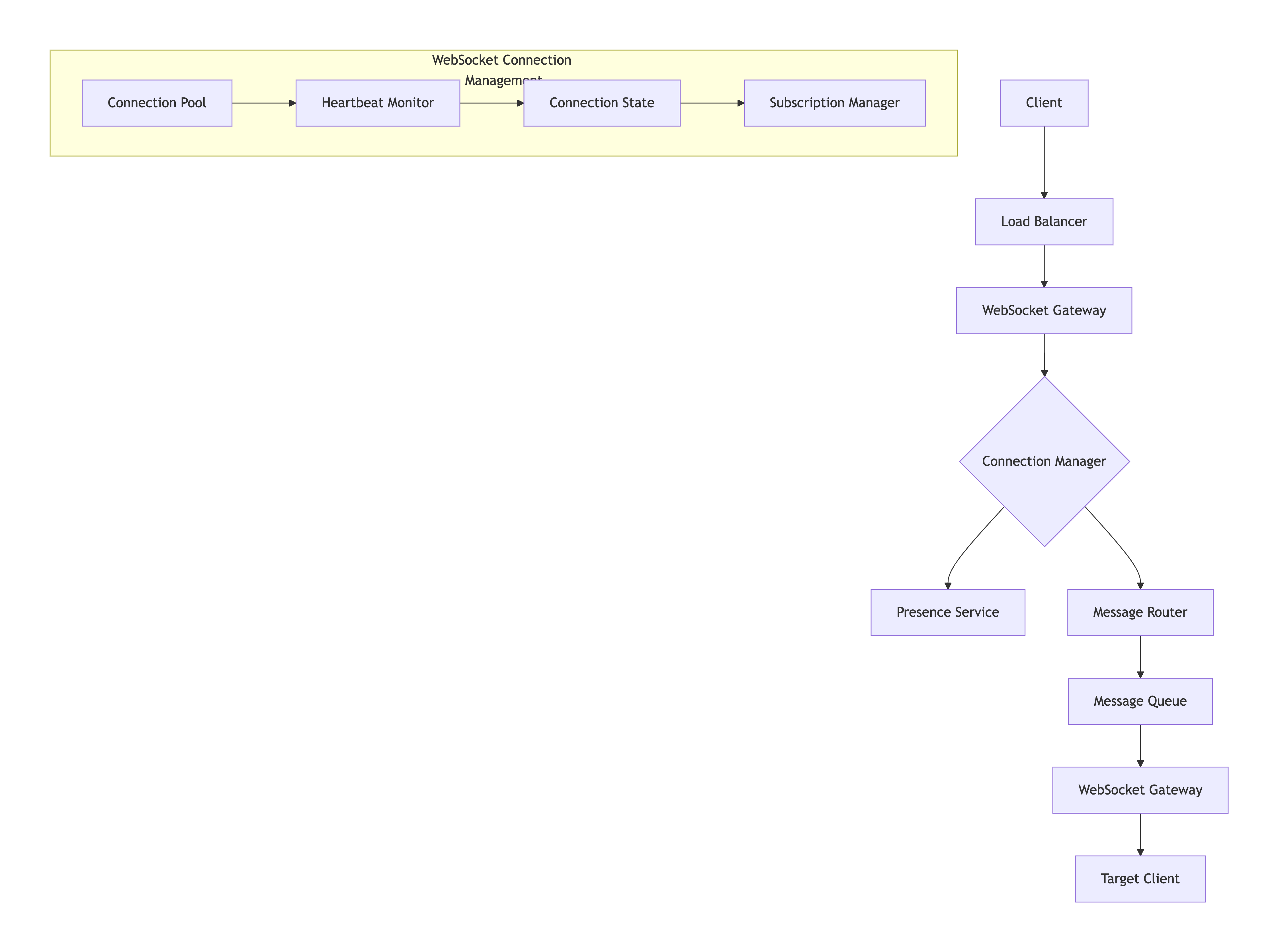
WebSocket Server Implementation:
typescript
class WebSocketGateway {
    private connections: Map<string, WebSocketConnection>;
    private userToConnections: Map<string, Set<string>>;
    private roomSubscriptions: Map<string, Set<string>>;

    async handleConnection(socket: WebSocket, userId: string): Promise<void> {
        const connectionId = this.generateConnectionId();
        const connection = new WebSocketConnection(connectionId, socket, userId);

        // Store connection
        this.connections.set(connectionId, connection);

        // Map user to multiple connections (multi-device support)
        if (!this.userToConnections.has(userId)) {
            this.userToConnections.set(userId, new Set());
        }
        this.userToConnections.get(userId)!.add(connectionId);

        // Send connection acknowledgment
        await this.send(connectionId, {
            type: 'connected',
            connectionId,
            serverTime: Date.now()
        });

        // Start heartbeat
        this.startHeartbeat(connectionId);

        // Update presence
        await this.presenceService.userOnline(userId);
    }

    async handleMessage(connectionId: string, message: any): Promise<void> {
        const connection = this.connections.get(connectionId);
        if (!connection) return;

        switch (message.type) {
            case 'ping':
                await this.handlePing(connectionId);
                break;
            case 'subscribe':
                await this.handleSubscribe(connectionId, message.roomId);
                break;
            case 'unsubscribe':
                await this.handleUnsubscribe(connectionId, message.roomId);
                break;
            case 'typing':
                await this.handleTypingIndicator(connectionId, message);
                break;
            case 'message':
                await this.handleNewMessage(connectionId, message);
                break;
            case 'read_receipt':
                await this.handleReadReceipt(connectionId, message);
                break;
        }
    }

    private async handleNewMessage(connectionId: string, message: any): Promise<void> {
        const connection = this.connections.get(connectionId)!;

        // Validate message
        const validated = await this.validateMessage(message);

        // Generate message ID
        const messageId = this.generateMessageId(connection.userId);

        // Store message
        await this.messageService.storeMessage({
            id: messageId,
            senderId: connection.userId,
            roomId: message.roomId,
            content: message.content,
            type: message.messageType || 'text',
            timestamp: Date.now(),
            metadata: message.metadata
        });

        // Publish to message queue
        await this.messageQueue.publish('chat.messages', {
            messageId,
            roomId: message.roomId,
            senderId: connection.userId,
            content: message.content,
            timestamp: Date.now()
        });

        // Send delivery receipt to sender
        await this.send(connectionId, {
            type: 'message_sent',
            clientMessageId: message.clientMessageId,
            serverMessageId: messageId,
            timestamp: Date.now()
        });
    }
}
4.2 Message Flow Architecture
text
Message Flow:
1. Client A → WebSocket Gateway → Message Validation
2. WebSocket Gateway → Message Service → Store in DB
3. Message Service → Kafka (chat.messages topic)
4. Message Router (consumes from Kafka)
   ↓
5. For each recipient:
   a. Check if online (Presence Service)
   b. If online: Route to appropriate WebSocket Gateway
   c. If offline: Store for later delivery
6. WebSocket Gateway → Client B
7. Client B sends read receipt
8. Update read status in DB
9. Notify sender via WebSocket
go
// Message Router in Go for high performance
type MessageRouter struct {
    kafkaConsumer    *kafka.Consumer
    presenceService  *PresenceService
    wsGateways       map[string]*WSGatewayClient
    messageStore     MessageStore
}

func (r *MessageRouter) Start() {
    for {
        msg, err := r.kafkaConsumer.Consume()
        if err != nil {
            log.Error("Failed to consume message", err)
            continue
        }

        go r.routeMessage(msg)
    }
}

func (r *MessageRouter) routeMessage(msg *Message) {
    // Get room members
    members, err := r.getRoomMembers(msg.RoomID)
    if err != nil {
        log.Error("Failed to get room members", err)
        return
    }

    // For each member
    for _, memberID := range members {
        // Skip sender
        if memberID == msg.SenderID {
            continue
        }

        // Check presence
        isOnline, connections := r.presenceService.GetUserConnections(memberID)

        if isOnline {
            // Real-time delivery
            for _, conn := range connections {
                gatewayClient := r.getGatewayClient(conn.GatewayID)
                gatewayClient.SendMessage(conn.ConnectionID, msg)
            }

            // Mark as delivered
            r.messageStore.MarkDelivered(msg.ID, memberID)
        } else {
            // Store for offline delivery
            r.messageStore.StoreOfflineMessage(msg.ID, memberID)

            // Queue push notification
            r.notificationService.QueuePushNotification(memberID, msg)
        }
    }
}
4.3 Data Storage Design
Message Storage (Cassandra Schema):
cql
-- Messages table (partitioned by room_id, clustered by timestamp)
CREATE TABLE messages (
    room_id uuid,
    message_id timeuuid,
    sender_id uuid,
    content text,
    message_type text,
    metadata map<text, text>,
    created_at timestamp,

    -- Index for quick lookup
    PRIMARY KEY ((room_id), message_id)
) WITH CLUSTERING ORDER BY (message_id DESC)
   AND compaction = {'class': 'TimeWindowCompactionStrategy'}
   AND default_time_to_live = 31536000; -- 1 year retention

-- Offline messages table
CREATE TABLE offline_messages (
    user_id uuid,
    room_id uuid,
    message_id timeuuid,
    created_at timestamp,
    PRIMARY KEY ((user_id), room_id, message_id)
);

-- Read receipts table
CREATE TABLE read_receipts (
    room_id uuid,
    user_id uuid,
    last_read_message_id timeuuid,
    updated_at timestamp,
    PRIMARY KEY ((room_id), user_id)
);

-- Message reactions
CREATE TABLE message_reactions (
    message_id timeuuid,
    user_id uuid,
    reaction text,
    created_at timestamp,
    PRIMARY KEY ((message_id), user_id)
);
User Data (PostgreSQL):
sql
-- Users table
CREATE TABLE users (
    id UUID PRIMARY KEY DEFAULT gen_random_uuid(),
    email VARCHAR(255) UNIQUE NOT NULL,
    phone VARCHAR(20) UNIQUE,
    username VARCHAR(50) UNIQUE NOT NULL,
    full_name VARCHAR(255),
    avatar_url TEXT,
    status VARCHAR(50) DEFAULT 'active',
    created_at TIMESTAMP DEFAULT CURRENT_TIMESTAMP,
    updated_at TIMESTAMP DEFAULT CURRENT_TIMESTAMP,

    -- JSONB for flexible metadata
    metadata JSONB DEFAULT '{}'
);

-- Contacts/relationships
CREATE TABLE contacts (
    user_id UUID REFERENCES users(id),
    contact_id UUID REFERENCES users(id),
    relationship VARCHAR(50) DEFAULT 'friend', -- friend, blocked, pending
    created_at TIMESTAMP DEFAULT CURRENT_TIMESTAMP,
    updated_at TIMESTAMP DEFAULT CURRENT_TIMESTAMP,
    PRIMARY KEY (user_id, contact_id)
);

-- Chat rooms
CREATE TABLE rooms (
    id UUID PRIMARY KEY DEFAULT gen_random_uuid(),
    name VARCHAR(255),
    type VARCHAR(20) DEFAULT 'direct', -- direct, group, channel
    created_by UUID REFERENCES users(id),
    created_at TIMESTAMP DEFAULT CURRENT_TIMESTAMP,
    metadata JSONB DEFAULT '{}'
);

-- Room members with roles
CREATE TABLE room_members (
    room_id UUID REFERENCES rooms(id),
    user_id UUID REFERENCES users(id),
    role VARCHAR(20) DEFAULT 'member', -- member, admin, owner
    joined_at TIMESTAMP DEFAULT CURRENT_TIMESTAMP,
    last_read_message_id UUID,
    muted_until TIMESTAMP,
    PRIMARY KEY (room_id, user_id)
);
Redis for Real-time State:
python
class PresenceService:
    def __init__(self, redis_client):
        self.redis = redis_client
        self.online_users_key = "online_users"
        self.user_connections_key = "user:connections:{user_id}"
        self.user_presence_key = "user:presence:{user_id}"

    async def user_online(self, user_id: str, connection_id: str, device_info: dict):
        # Add to online users set
        await self.redis.sadd(self.online_users_key, user_id)

        # Store connection info
        connections_key = self.user_connections_key.format(user_id=user_id)
        connection_data = {
            'connection_id': connection_id,
            'device_info': json.dumps(device_info),
            'last_seen': time.time()
        }
        await self.redis.hset(connections_key, connection_id, json.dumps(connection_data))

        # Set presence status with expiry
        presence_key = self.user_presence_key.format(user_id=user_id)
        await self.redis.setex(presence_key, 60, "online")  # Refresh every 60 seconds

        # Publish presence update
        await self.redis.publish(f"presence:{user_id}", json.dumps({
            'user_id': user_id,
            'status': 'online',
            'timestamp': time.time()
        }))

    async def user_offline(self, user_id: str, connection_id: str):
        # Remove connection
        connections_key = self.user_connections_key.format(user_id=user_id)
        await self.redis.hdel(connections_key, connection_id)

        # Check if user has any remaining connections
        remaining_connections = await self.redis.hlen(connections_key)

        if remaining_connections == 0:
            # Remove from online users set
            await self.redis.srem(self.online_users_key, user_id)

            # Update presence status
            presence_key = self.user_presence_key.format(user_id=user_id)
            await self.redis.setex(presence_key, 300, "offline")  # Keep for 5 minutes

            # Publish presence update
            await self.redis.publish(f"presence:{user_id}", json.dumps({
                'user_id': user_id,
                'status': 'offline',
                'timestamp': time.time()
            }))
4.4 Message Queue Architecture
java
// Kafka topics configuration
public class KafkaConfig {
    @Bean
    public NewTopic chatMessagesTopic() {
        return TopicBuilder.name("chat.messages")
                .partitions(100)  // Partition by room_id hash
                .replicas(3)
                .config(TopicConfig.RETENTION_MS_CONFIG, "604800000") // 7 days
                .build();
    }

    @Bean
    public NewTopic typingIndicatorsTopic() {
        return TopicBuilder.name("chat.typing")
                .partitions(50)
                .replicas(2)
                .config(TopicConfig.RETENTION_MS_CONFIG, "86400000") // 1 day
                .build();
    }

    @Bean
    public NewTopic presenceEventsTopic() {
        return TopicBuilder.name("presence.events")
                .partitions(30)
                .replicas(2)
                .config(TopicConfig.RETENTION_MS_CONFIG, "86400000")
                .build();
    }

    @Bean
    public NewTopic notificationEventsTopic() {
        return TopicBuilder.name("notifications.events")
                .partitions(50)
                .replicas(2)
                .build();
    }
}

// Message producer with partitioning
@Component
public class MessageProducer {
    private final KafkaTemplate<String, ChatMessage> kafkaTemplate;

    public void sendMessage(ChatMessage message) {
        // Partition by room_id for message ordering guarantee
        int partition = Math.abs(message.getRoomId().hashCode()) % 100;

        kafkaTemplate.send(
            "chat.messages",
            partition,
            message.getRoomId(),
            message
        ).addCallback(
            result -> log.info("Message sent successfully"),
            ex -> log.error("Failed to send message", ex)
        );
    }

    public void sendTypingIndicator(String roomId, String userId, boolean isTyping) {
        TypingEvent event = new TypingEvent(roomId, userId, isTyping, System.currentTimeMillis());

        // Use consistent hashing for same user typing events
        String key = roomId + ":" + userId;

        kafkaTemplate.send("chat.typing", key, event);
    }
}
4.5 Media Handling Service
typescript
class MediaService {
    private s3Client: AWS.S3;
    private imageProcessor: Sharp;
    private videoProcessor: FFmpeg;

    async uploadMedia(
        file: Buffer,
        userId: string,
        metadata: MediaMetadata
    ): Promise<MediaResponse> {
        // Generate unique media ID
        const mediaId = crypto.randomUUID();

        // Determine storage path
        const path = `media/${userId}/${Date.now()}-${mediaId}`;

        // Process based on type
        let processedFile: Buffer;
        let thumbnail: Buffer | null = null;

        switch (metadata.type) {
            case 'image':
                processedFile = await this.processImage(file, metadata);
                thumbnail = await this.generateThumbnail(processedFile);
                break;
            case 'video':
                processedFile = await this.processVideo(file, metadata);
                thumbnail = await this.extractVideoThumbnail(file);
                break;
            case 'audio':
                processedFile = await this.processAudio(file, metadata);
                break;
            default:
                processedFile = file;
        }

        // Upload to S3
        const uploadParams = {
            Bucket: process.env.MEDIA_BUCKET,
            Key: path,
            Body: processedFile,
            ContentType: metadata.mimeType,
            Metadata: {
                'user-id': userId,
                'media-id': mediaId,
                'original-filename': metadata.filename
            }
        };

        await this.s3Client.putObject(uploadParams);

        // Upload thumbnail if exists
        let thumbnailUrl: string | null = null;
        if (thumbnail) {
            const thumbnailPath = `thumbnails/${userId}/${mediaId}.jpg`;
            await this.s3Client.putObject({
                Bucket: process.env.MEDIA_BUCKET,
                Key: thumbnailPath,
                Body: thumbnail,
                ContentType: 'image/jpeg'
            });
            thumbnailUrl = await this.getCDNUrl(thumbnailPath);
        }

        // Store metadata in database
        await this.storeMediaMetadata({
            id: mediaId,
            userId,
            path,
            type: metadata.type,
            mimeType: metadata.mimeType,
            size: processedFile.length,
            dimensions: metadata.dimensions,
            duration: metadata.duration,
            thumbnailUrl,
            createdAt: new Date()
        });

        return {
            mediaId,
            url: await this.getCDNUrl(path),
            thumbnailUrl,
            size: processedFile.length
        };
    }

    private async processImage(file: Buffer, metadata: MediaMetadata): Promise<Buffer> {
        const image = this.imageProcessor(file);

        // Resize if too large
        if (metadata.dimensions &&
            (metadata.dimensions.width > 1920 || metadata.dimensions.height > 1920)) {
            image.resize(1920, 1920, { fit: 'inside' });
        }

        // Compress
        image.jpeg({ quality: 85 });

        return await image.toBuffer();
    }

    private async generateThumbnail(image: Buffer): Promise<Buffer> {
        return await this.imageProcessor(image)
            .resize(300, 300, { fit: 'cover' })
            .jpeg({ quality: 70 })
            .toBuffer();
    }
}
5. Scalability Patterns
5.1 WebSocket Connection Scaling
go
// WebSocket Gateway with consistent hashing
type GatewayManager struct {
    gateways      map[string]*GatewayInfo
    hashRing      *consistenthash.Map
    redisClient   *redis.Client
}

func (gm *GatewayManager) RegisterGateway(gatewayID string, gatewayInfo GatewayInfo) {
    gm.gateways[gatewayID] = &gatewayInfo

    // Add to hash ring with weight based on capacity
    gm.hashRing.Add(gatewayID)

    // Store in Redis for service discovery
    gm.redisClient.HSet("chat:gateways", gatewayID, gatewayInfo.ToJSON())
}

func (gm *GatewayManager) GetGatewayForUser(userID string) (string, error) {
    // Consistent hashing for user-to-gateway mapping
    gatewayID, ok := gm.hashRing.Get(userID)
    if !ok {
        return "", errors.New("no gateway available")
    }
    return gatewayID, nil
}

func (gm *GatewayManager) RouteMessage(userID string, message Message) error {
    gatewayID, err := gm.GetGatewayForUser(userID)
    if err != nil {
        return err
    }

    gateway, exists := gm.gateways[gatewayID]
    if !exists {
        return errors.New("gateway not found")
    }

    // Forward message to appropriate gateway
    return gm.sendToGateway(gateway, userID, message)
}
5.2 Database Sharding Strategy
sql
-- Sharding by user_id for messages
-- Using Citus (PostgreSQL extension) for distributed tables

-- Enable Citus extension
CREATE EXTENSION citus;

-- Create distributed tables
SELECT create_distributed_table('messages', 'room_id');
SELECT create_distributed_table('users', 'id');
SELECT create_distributed_table('room_members', 'room_id');

-- Configure shard count based on data size
SET citus.shard_count = 64;  -- For messages table
SET citus.shard_replication_factor = 2;

-- Create reference tables (small, replicated to all nodes)
SELECT create_reference_table('rooms');

-- Query optimization with colocation
-- Rooms and messages are colocated by room_id
SELECT mark_tables_colocated('rooms', 'messages');
5.3 Caching Strategy
python
class ChatCache:
    def __init__(self):
        self.redis = RedisCluster()
        self.local_cache = {}  # In-memory cache for hot data

    async def get_user_presence(self, user_id: str) -> Optional[str]:
        # Check local cache first
        if user_id in self.local_cache.get('presence', {}):
            return self.local_cache['presence'][user_id]

        # Check Redis
        presence = await self.redis.get(f"presence:{user_id}")

        if presence:
            # Update local cache with TTL
            self.local_cache.setdefault('presence', {})[user_id] = presence

            # Schedule local cache eviction
            asyncio.create_task(self.evict_from_local_cache('presence', user_id, 30))

        return presence

    async def get_room_members(self, room_id: str) -> List[str]:
        cache_key = f"room:{room_id}:members"

        # Try to get from Redis
        members = await self.redis.get(cache_key)
        if members:
            return json.loads(members)

        # Get from database
        members = await self.db.get_room_members(room_id)

        # Store in Redis with expiration
        await self.redis.setex(cache_key, 300, json.dumps(members))

        return members

    async def get_message_history(self, room_id: str, limit: int = 50, offset: int = 0):
        cache_key = f"room:{room_id}:messages:{limit}:{offset}"

        # Use Redis sorted set for message history caching
        cached = await self.redis.zrevrange(cache_key, 0, -1)

        if cached and len(cached) >= limit:
            return [json.loads(msg) for msg in cached]

        # Get from database
        messages = await self.db.get_messages(room_id, limit, offset)

        # Cache in Redis with TTL
        pipeline = self.redis.pipeline()
        for msg in messages:
            pipeline.zadd(cache_key, {json.dumps(msg): msg['timestamp']})
        pipeline.expire(cache_key, 600)  # 10 minutes
        await pipeline.execute()

        return messages
6. Real-time Features Implementation
6.1 Typing Indicators
typescript
class TypingIndicatorService {
    private typingSessions: Map<string, TypingSession> = new Map();

    async handleTypingStart(userId: string, roomId: string): Promise<void> {
        const sessionKey = `${userId}:${roomId}`;

        // Check if already typing
        if (this.typingSessions.has(sessionKey)) {
            return;
        }

        // Create new typing session
        const session: TypingSession = {
            userId,
            roomId,
            startedAt: Date.now(),
            lastActionAt: Date.now()
        };

        this.typingSessions.set(sessionKey, session);

        // Notify room members
        await this.notifyRoom(roomId, {
            type: 'typing_start',
            userId,
            roomId,
            timestamp: Date.now()
        });

        // Schedule cleanup if user stops typing
        setTimeout(() => {
            this.checkAndCleanupSession(sessionKey);
        }, 3000);
    }

    async handleTypingStop(userId: string, roomId: string): Promise<void> {
        const sessionKey = `${userId}:${roomId}`;

        if (this.typingSessions.has(sessionKey)) {
            this.typingSessions.delete(sessionKey);

            // Notify room members
            await this.notifyRoom(roomId, {
                type: 'typing_stop',
                userId,
                roomId,
                timestamp: Date.now()
            });
        }
    }

    private checkAndCleanupSession(sessionKey: string): void {
        const session = this.typingSessions.get(sessionKey);
        if (!session) return;

        // If no action for 3 seconds, assume stopped typing
        if (Date.now() - session.lastActionAt > 3000) {
            this.typingSessions.delete(sessionKey);
            this.notifyRoom(session.roomId, {
                type: 'typing_stop',
                userId: session.userId,
                roomId: session.roomId,
                timestamp: Date.now()
            });
        }
    }
}
6.2 Read Receipts
java
public class ReadReceiptService {
    private final MessageRepository messageRepository;
    private final NotificationService notificationService;

    @Transactional
    public void markMessagesAsRead(String userId, String roomId, String lastReadMessageId) {
        // Update last read message for user in this room
        messageRepository.updateLastReadMessage(userId, roomId, lastReadMessageId);

        // Get messages that are now read
        List<Message> newlyReadMessages = messageRepository
            .findMessagesBefore(userId, roomId, lastReadMessageId);

        // Update read status for each message
        for (Message message : newlyReadMessages) {
            messageRepository.addReadReceipt(
                message.getId(),
                userId,
                Instant.now()
            );
        }

        // Notify sender(s) that their messages were read
        Set<String> senders = newlyReadMessages.stream()
            .map(Message::getSenderId)
            .collect(Collectors.toSet());

        for (String senderId : senders) {
            if (!senderId.equals(userId)) {
                notificationService.notifyMessageRead(
                    senderId,
                    roomId,
                    lastReadMessageId,
                    userId
                );
            }
        }
    }

    public MessageReadStatus getReadStatus(String messageId) {
        List<ReadReceipt> receipts = messageRepository
            .findReadReceipts(messageId);

        Set<String> readBy = receipts.stream()
            .map(ReadReceipt::getUserId)
            .collect(Collectors.toSet());

        // Get room members
        Message message = messageRepository.findById(messageId);
        List<String> roomMembers = messageRepository
            .getRoomMembers(message.getRoomId());

        // Calculate delivery status
        Set<String> deliveredTo = new HashSet<>();
        Set<String> pendingDelivery = new HashSet<>();

        for (String memberId : roomMembers) {
            if (memberId.equals(message.getSenderId())) {
                continue;
            }

            // Check if user was in room when message was sent
            if (wasUserInRoom(memberId, message.getRoomId(), message.getTimestamp())) {
                if (readBy.contains(memberId)) {
                    // Message was read
                } else if (isUserOnline(memberId)) {
                    // Message was delivered but not read
                    deliveredTo.add(memberId);
                } else {
                    // Message not yet delivered
                    pendingDelivery.add(memberId);
                }
            }
        }

        return new MessageReadStatus(
            messageId,
            readBy,
            deliveredTo,
            pendingDelivery
        );
    }
}
7. Security & Encryption
7.1 End-to-End Encryption
typescript
class EndToEndEncryption {
    private readonly crypto = new WebCrypto();

    async generateKeyPair(): Promise<CryptoKeyPair> {
        return await this.crypto.subtle.generateKey(
            {
                name: "ECDH",
                namedCurve: "P-256"
            },
            true, // extractable
            ["deriveKey"]
        );
    }

    async encryptMessage(
        message: string,
        senderPrivateKey: CryptoKey,
        recipientPublicKey: CryptoKey
    ): Promise<EncryptedMessage> {
        // Generate ephemeral key pair for forward secrecy
        const ephemeralKeyPair = await this.generateKeyPair();

        // Derive shared secret
        const sharedSecret = await this.crypto.subtle.deriveKey(
            {
                name: "ECDH",
                public: recipientPublicKey
            },
            senderPrivateKey,
            {
                name: "AES-GCM",
                length: 256
            },
            true,
            ["encrypt"]
        );

        // Generate random IV
        const iv = this.crypto.getRandomValues(new Uint8Array(12));

        // Encrypt message
        const encryptedContent = await this.crypto.subtle.encrypt(
            {
                name: "AES-GCM",
                iv: iv
            },
            sharedSecret,
            new TextEncoder().encode(message)
        );

        return {
            ciphertext: this.arrayBufferToBase64(encryptedContent),
            ephemeralPublicKey: await this.exportPublicKey(ephemeralKeyPair.publicKey),
            iv: this.arrayBufferToBase64(iv),
            signature: await this.signMessage(message, senderPrivateKey)
        };
    }

    async decryptMessage(
        encrypted: EncryptedMessage,
        recipientPrivateKey: CryptoKey,
        senderPublicKey: CryptoKey
    ): Promise<string> {
        // Import ephemeral public key
        const ephemeralPublicKey = await this.importPublicKey(encrypted.ephemeralPublicKey);

        // Derive shared secret
        const sharedSecret = await this.crypto.subtle.deriveKey(
            {
                name: "ECDH",
                public: ephemeralPublicKey
            },
            recipientPrivateKey,
            {
                name: "AES-GCM",
                length: 256
            },
            true,
            ["decrypt"]
        );

        // Decrypt message
        const decrypted = await this.crypto.subtle.decrypt(
            {
                name: "AES-GCM",
                iv: this.base64ToArrayBuffer(encrypted.iv)
            },
            sharedSecret,
            this.base64ToArrayBuffer(encrypted.ciphertext)
        );

        const message = new TextDecoder().decode(decrypted);

        // Verify signature
        const isValid = await this.verifySignature(
            message,
            encrypted.signature,
            senderPublicKey
        );

        if (!isValid) {
            throw new Error("Invalid message signature");
        }

        return message;
    }
}
7.2 Rate Limiting & Abuse Prevention
go
type RateLimiter struct {
    redisClient *redis.Client
    limits      map[string]RateLimitConfig
}

type RateLimitConfig struct {
    Requests int
    Window   time.Duration
    Burst    int
}

func (rl *RateLimiter) CheckLimit(userID, action string) (bool, error) {
    key := fmt.Sprintf("ratelimit:%s:%s", userID, action)
    config, exists := rl.limits[action]

    if !exists {
        return true, nil // No limit configured
    }

    // Use Redis sorted set for sliding window
    now := time.Now().UnixMilli()
    windowStart := now - config.Window.Milliseconds()

    // Remove old entries
    rl.redisClient.ZRemRangeByScore(key, "0", strconv.FormatInt(windowStart, 10))

    // Count current requests
    count, err := rl.redisClient.ZCard(key).Result()
    if err != nil {
        return false, err
    }

    if int(count) >= config.Requests {
        // Check burst allowance
        burstKey := fmt.Sprintf("burst:%s:%s", userID, action)
        burstCount, _ := rl.redisClient.Get(burstKey).Int()

        if burstCount >= config.Burst {
            return false, nil
        }

        // Allow burst
        rl.redisClient.Incr(burstKey)
        rl.redisClient.Expire(burstKey, config.Window)
    }

    // Add new request
    rl.redisClient.ZAdd(key, redis.Z{
        Score:  float64(now),
        Member: strconv.FormatInt(now, 10),
    })
    rl.redisClient.Expire(key, config.Window)

    return true, nil
}

// Configure limits
limiter := &RateLimiter{
    limits: map[string]RateLimitConfig{
        "send_message": {Requests: 60, Window: time.Minute, Burst: 10},
        "create_room":  {Requests: 10, Window: time.Hour, Burst: 3},
        "add_member":   {Requests: 100, Window: time.Hour, Burst: 20},
        "typing":       {Requests: 30, Window: time.Minute, Burst: 5},
    },
}
8. Search & Indexing
python
class MessageSearchService:
    def __init__(self, elasticsearch_client):
        self.es = elasticsearch_client
        self.index_name = "chat_messages"

    async def index_message(self, message: dict):
        # Create document for indexing
        doc = {
            "message_id": message["id"],
            "room_id": message["room_id"],
            "sender_id": message["sender_id"],
            "content": message["content"],
            "content_type": message.get("type", "text"),
            "timestamp": message["timestamp"],
            "attachments": message.get("attachments", []),
            "mentions": self.extract_mentions(message["content"])
        }

        # Index in Elasticsearch
        await self.es.index(
            index=self.index_name,
            id=message["id"],
            document=doc,
            refresh="wait_for"
        )

    async def search_messages(
        self,
        user_id: str,
        query: str,
        filters: dict,
        page: int = 1,
        size: int = 20
    ):
        # Get user's accessible rooms
        accessible_rooms = await self.get_accessible_rooms(user_id)

        # Build Elasticsearch query
        search_body = {
            "query": {
                "bool": {
                    "must": [
                        {
                            "simple_query_string": {
                                "query": query,
                                "fields": ["content"],
                                "default_operator": "AND"
                            }
                        },
                        {
                            "terms": {
                                "room_id": accessible_rooms
                            }
                        }
                    ],
                    "filter": self.build_filters(filters)
                }
            },
            "sort": [
                {"timestamp": {"order": "desc"}}
            ],
            "from": (page - 1) * size,
            "size": size,
            "highlight": {
                "fields": {
                    "content": {
                        "number_of_fragments": 3,
                        "fragment_size": 150
                    }
                }
            }
        }

        response = await self.es.search(
            index=self.index_name,
            body=search_body
        )

        # Process results
        results = []
        for hit in response["hits"]["hits"]:
            result = {
                "message_id": hit["_source"]["message_id"],
                "room_id": hit["_source"]["room_id"],
                "sender_id": hit["_source"]["sender_id"],
                "content": hit["_source"]["content"],
                "timestamp": hit["_source"]["timestamp"],
                "score": hit["_score"],
                "highlight": hit.get("highlight", {})
            }
            results.append(result)

        return {
            "results": results,
            "total": response["hits"]["total"]["value"],
            "page": page,
            "total_pages": math.ceil(response["hits"]["total"]["value"] / size)
        }

    def build_filters(self, filters: dict) -> list:
        filter_list = []

        if filters.get("room_id"):
            filter_list.append({"term": {"room_id": filters["room_id"]}})

        if filters.get("sender_id"):
            filter_list.append({"term": {"sender_id": filters["sender_id"]}})

        if filters.get("date_from") and filters.get("date_to"):
            filter_list.append({
                "range": {
                    "timestamp": {
                        "gte": filters["date_from"],
                        "lte": filters["date_to"]
                    }
                }
            })

        if filters.get("has_attachment"):
            filter_list.append({"exists": {"field": "attachments"}})

        if filters.get("mentioned_user"):
            filter_list.append({"term": {"mentions": filters["mentioned_user"]}})

        return filter_list
9. Push Notifications
typescript
class PushNotificationService {
    private apns: apns.Provider;
    private fcm: admin.messaging.Messaging;
    private webPush: webpush.WebPush;

    async sendNotification(
        userId: string,
        notification: NotificationPayload
    ): Promise<void> {
        // Get user's devices
        const devices = await this.getUserDevices(userId);

        // Group devices by platform
        const groupedDevices = this.groupDevicesByPlatform(devices);

        // Send to each platform
        const promises = [];

        // iOS (APNs)
        if (groupedDevices.ios.length > 0) {
            promises.push(this.sendAPNS(groupedDevices.ios, notification));
        }

        // Android (FCM)
        if (groupedDevices.android.length > 0) {
            promises.push(this.sendFCM(groupedDevices.android, notification));
        }

        // Web (Web Push)
        if (groupedDevices.web.length > 0) {
            promises.push(this.sendWebPush(groupedDevices.web, notification));
        }

        await Promise.all(promises);
    }

    private async sendAPNS(deviceTokens: string[], notification: NotificationPayload) {
        const notifications = deviceTokens.map(token => ({
            deviceToken: token,
            body: {
                aps: {
                    alert: {
                        title: notification.title,
                        body: notification.body,
                    },
                    badge: notification.badge || 1,
                    sound: "default",
                    "thread-id": notification.threadId,
                    "mutable-content": 1
                },
                data: notification.data
            }
        }));

        return this.apns.sendMany(notifications);
    }

    private async sendFCM(deviceTokens: string[], notification: NotificationPayload) {
        const message: admin.messaging.MulticastMessage = {
            tokens: deviceTokens,
            notification: {
                title: notification.title,
                body: notification.body,
                imageUrl: notification.imageUrl
            },
            data: notification.data,
            android: {
                priority: "high",
                notification: {
                    channelId: "chat_messages",
                    icon: "ic_notification",
                    color: "#2196F3",
                    tag: notification.threadId,
                    clickAction: "OPEN_CHAT"
                }
            },
            apns: {
                payload: {
                    aps: {
                        badge: notification.badge || 1,
                        sound: "default"
                    }
                }
            }
        };

        return this.fcm.sendMulticast(message);
    }

    private async sendWebPush(subscriptions: PushSubscription[], notification: NotificationPayload) {
        const payload = JSON.stringify({
            title: notification.title,
            body: notification.body,
            icon: notification.icon || "/icon-192.png",
            badge: notification.badgeIcon || "/badge-72.png",
            tag: notification.threadId,
            data: notification.data,
            actions: [
                {
                    action: "reply",
                    title: "Reply",
                    icon: "/reply-icon.png"
                },
                {
                    action: "mark_read",
                    title: "Mark as Read"
                }
            ],
            vibrate: [200, 100, 200],
            timestamp: Date.now(),
            requireInteraction: true
        });

        const promises = subscriptions.map(async subscription => {
            try {
                await this.webPush.sendNotification(subscription, payload);
            } catch (error) {
                // If subscription is invalid, remove it
                if (error.statusCode === 410) {
                    await this.removeInvalidSubscription(subscription);
                }
            }
        });

        await Promise.all(promises);
    }
}
10. Monitoring & Analytics
python
class ChatAnalytics:
    def __init__(self):
        self.statsd_client = statsd.StatsClient()
        self.prometheus_registry = CollectorRegistry()

        # Define metrics
        self.messages_sent = Counter(
            'chat_messages_sent_total',
            'Total messages sent',
            ['room_type', 'message_type'],
            registry=self.prometheus_registry
        )

        self.message_delivery_latency = Histogram(
            'chat_message_delivery_latency_seconds',
            'Message delivery latency',
            ['room_type'],
            buckets=[0.01, 0.05, 0.1, 0.5, 1, 5],
            registry=self.prometheus_registry
        )

        self.active_connections = Gauge(
            'chat_active_connections',
            'Number of active WebSocket connections',
            registry=self.prometheus_registry
        )

    async def track_message_sent(self, message: dict):
        # Increment counter
        self.messages_sent.labels(
            room_type=message.get('room_type', 'direct'),
            message_type=message.get('type', 'text')
        ).inc()

        # Track to StatsD
        self.statsd_client.incr('messages.sent', tags=[
            f"room_type:{message.get('room_type', 'direct')}",
            f"message_type:{message.get('type', 'text')}"
        ])

    async def track_message_delivery(self, message_id: str, sent_time: int, delivered_time: int):
        latency = (delivered_time - sent_time) / 1000.0  # Convert to seconds

        self.message_delivery_latency.labels(
            room_type=self.get_room_type(message_id)
        ).observe(latency)

        # Log to Elasticsearch for detailed analysis
        await self.es.index(
            index='chat_delivery_metrics',
            body={
                'message_id': message_id,
                'sent_time': sent_time,
                'delivered_time': delivered_time,
                'latency': latency,
                '@timestamp': datetime.utcnow()
            }
        )

    async def generate_daily_report(self, date: datetime):
        # Get message volume by hour
        message_volume = await self.get_message_volume_by_hour(date)

        # Get active users
        active_users = await self.get_active_users(date)

        # Get delivery success rate
        delivery_rate = await self.get_delivery_success_rate(date)

        # Get top rooms by activity
        top_rooms = await self.get_top_rooms(date, limit=10)

        # Generate report
        report = {
            'date': date.isoformat(),
            'total_messages': sum(hour['count'] for hour in message_volume),
            'unique_active_users': len(active_users),
            'delivery_success_rate': delivery_rate,
            'peak_hour': max(message_volume, key=lambda x: x['count']),
            'top_rooms': top_rooms,
            'message_types': await self.get_message_type_distribution(date),
            'platform_distribution': await self.get_platform_distribution(date)
        }

        # Store report
        await self.es.index(
            index='chat_daily_reports',
            id=date.strftime('%Y-%m-%d'),
            body=report
        )

        return report
11. Testing Strategy
typescript
describe('Chat System', () => {
    describe('WebSocket Connection', () => {
        it('should establish connection successfully', async () => {
            const ws = new WebSocket('ws://localhost:8080/chat');

            await new Promise((resolve) => {
                ws.onopen = resolve;
            });

            expect(ws.readyState).toBe(WebSocket.OPEN);
        });

        it('should handle multiple connections per user', async () => {
            // Simulate user connecting from multiple devices
            const connections = await Promise.all([
                connectUser('user1'),
                connectUser('user1'),
                connectUser('user1')
            ]);

            // All connections should be active
            connections.forEach(conn => {
                expect(conn.status).toBe('connected');
            });

            // Presence service should show user as online
            const presence = await presenceService.getPresence('user1');
            expect(presence).toBe('online');
        });
    });

    describe('Message Delivery', () => {
        it('should deliver messages in order', async () => {
            const [user1, user2] = await setupTestUsers();

            // Send 100 messages quickly
            const messages = [];
            for (let i = 0; i < 100; i++) {
                messages.push(user1.sendMessage(user2.id, `Message ${i}`));
            }

            await Promise.all(messages);

            // Verify all messages received in order
            const received = user2.getReceivedMessages();
            expect(received.length).toBe(100);

            for (let i = 0; i < 100; i++) {
                expect(received[i].content).toBe(`Message ${i}`);
            }
        });

        it('should handle delivery to offline users', async () => {
            const [user1, user2] = await setupTestUsers();

            // User2 goes offline
            await user2.disconnect();

            // Send message
            await user1.sendMessage(user2.id, 'Offline message');

            // User2 comes back online
            await user2.connect();

            // Should receive pending message
            await waitFor(() => {
                expect(user2.getReceivedMessages().length).toBe(1);
            });
        });
    });

    describe('Performance Tests', () => {
        it('should handle 10,000 concurrent connections', async () => {
            const connections = [];

            // Create 10,000 connections
            for (let i = 0; i < 10000; i++) {
                connections.push(createConnection(`user${i}`));
            }

            await Promise.all(connections);

            // Verify all connected
            const connected = connections.filter(c => c.isConnected());
            expect(connected.length).toBe(10000);
        }, 30000);

        it('should process 1,000 messages per second', async () => {
            const startTime = Date.now();
            const messageCount = 5000;

            // Send messages in parallel
            const promises = [];
            for (let i = 0; i < messageCount; i++) {
                promises.push(sendTestMessage(i));
            }

            await Promise.all(promises);

            const endTime = Date.now();
            const duration = (endTime - startTime) / 1000; // seconds

            const messagesPerSecond = messageCount / duration;
            expect(messagesPerSecond).toBeGreaterThan(1000);
        });
    });
});
12. Deployment & DevOps
yaml
# Kubernetes deployment configuration
apiVersion: apps/v1
kind: Deployment
metadata:
  name: websocket-gateway
spec:
  replicas: 10
  strategy:
    type: RollingUpdate
    rollingUpdate:
      maxSurge: 2
      maxUnavailable: 1
  selector:
    matchLabels:
      app: websocket-gateway
  template:
    metadata:
      labels:
        app: websocket-gateway
    spec:
      containers:
      - name: gateway
        image: chat-gateway:latest
        ports:
        - containerPort: 8080
        env:
        - name: NODE_ENV
          value: production
        - name: REDIS_HOST
          value: redis-cluster
        - name: KAFKA_BROKERS
          value: kafka-0.kafka:9092,kafka-1.kafka:9092
        resources:
          requests:
            memory: "512Mi"
            cpu: "250m"
          limits:
            memory: "1Gi"
            cpu: "500m"
        livenessProbe:
          httpGet:
            path: /health
            port: 8080
          initialDelaySeconds: 30
          periodSeconds: 10
        readinessProbe:
          httpGet:
            path: /ready
            port: 8080
          initialDelaySeconds: 5
          periodSeconds: 5
---
# Horizontal Pod Autoscaler
apiVersion: autoscaling/v2
kind: HorizontalPodAutoscaler
metadata:
  name: websocket-gateway-hpa
spec:
  scaleTargetRef:
    apiVersion: apps/v1
    kind: Deployment
    name: websocket-gateway
  minReplicas: 5
  maxReplicas: 50
  metrics:
  - type: Resource
    resource:
      name: cpu
      target:
        type: Utilization
        averageUtilization: 70
  - type: Resource
    resource:
      name: memory
      target:
        type: Utilization
        averageUtilization: 80
  - type: Pods
    pods:
      metric:
        name: connections_per_pod
      target:
        type: AverageValue
        averageValue: 10000
Key Challenges & Solutions:
-
Connection State Management:
-
Use Redis for distributed connection tracking
-
Implement heartbeat mechanism
-
Graceful reconnection with session recovery
-
-
Message Ordering:
-
Use sequence numbers or timestamps
-
Partition Kafka topics by room_id
-
Client-side buffering and reordering
-
-
Offline Support:
-
Store undelivered messages
-
Sync on reconnection
-
Conflict resolution for concurrent edits
-
-
Scale to Millions:
-
Shard by user_id or room_id
-
Use connection pooling
-
Implement rate limiting
-
-
Data Privacy:
-
End-to-end encryption
-
Ephemeral messages
-
Data retention policies
-
-
Cost Optimization:
-
Compress messages
-
Use efficient protocols (Protobuf over JSON)
-
Implement message batching
-
Use spot instances for non-critical services
-
Advanced Features Roadmap:
-
Voice/Video Calls: WebRTC integration
-
Screen Sharing: SDP/ICE protocol implementation
-
Bots & Automation: Plugin architecture
-
Message Translation: Real-time translation service
-
Reactions & Polls: Rich interactive messages
-
Message Scheduling: Send later functionality
-
Advanced Search: Semantic search, image search
-
Chat Bots: AI-powered assistants
-
Marketplace Integration: E-commerce within chats
-
AR/VR Chat: 3D spatial audio/video
This system design provides a robust, scalable foundation for a real-time chat application that can handle millions of users while maintaining low latency, high availability, and strong security.


Comments (0)
No comments yet. Be the first to comment!