
Backend & APIs Topic
Solar Energy IoT Devices - System Design
1. Problem Statement
Design a scalable IoT system for monitoring and managing distributed solar energy installations. The system should:
-
Collect real-time data from solar panels and inverters
-
Monitor energy production, consumption, and battery storage
-
Enable remote control and optimization
-
Provide predictive maintenance
-
Handle millions of devices globally
2. System Requirements
Functional Requirements:
-
Data Collection:
-
Panel-level metrics (voltage, current, temperature)
-
Inverter performance data
-
Battery charge/discharge cycles
-
Weather conditions
-
Energy consumption patterns
-
-
Monitoring & Control:
-
Real-time dashboard
-
Alerts for anomalies
-
Remote device configuration
-
Firmware updates OTA (Over-The-Air)
-
-
Analytics & Insights:
-
Performance prediction
-
Maintenance scheduling
-
Energy optimization recommendations
-
ROI calculations
-
-
Integration:
-
Grid connectivity
-
Smart home systems
-
Utility company APIs
-
Mobile applications
-
Non-Functional Requirements:
-
Scalability: Support 10M+ devices
-
Reliability: 99.99% uptime
-
Latency: < 2 seconds for critical alerts
-
Security: End-to-end encryption, device authentication
-
Cost: Optimized for low bandwidth usage
-
Compliance: GDPR, regional energy regulations
3. High-Level Architecture
text
┌─────────────────────────────────────────────────────────────────────┐
│                        Client Applications                          │
├─────────────────┬─────────────────┬─────────────────┬──────────────┤
│   Web Dashboard │  Mobile Apps    │  3rd Party APIs │  Admin Tools │
└─────────────────┴─────────────────┴─────────────────┴──────────────┘
                                   │
┌──────────────────────────────────▼──────────────────────────────────┐
│                     API Gateway & Load Balancer                     │
│                        (Rate Limiting, Auth)                        │
└──────────────────────────────────┬──────────────────────────────────┘
                                   │
┌──────────────────────────────────▼──────────────────────────────────┐
│                     Microservices Ecosystem                         │
├─────────────┬─────────────┬─────────────┬─────────────┬─────────────┤
│ Device Mgmt │ Data Ingest │ Analytics   │ Alert Engine│ Control Svc│
│             │             │             │             │             │
├─────────────┴─────────────┴─────────────┴─────────────┴─────────────┤
│                    Service Mesh & Discovery                         │
└──────────────────────────────────┬──────────────────────────────────┘
                                   │
┌──────────────────────────────────▼──────────────────────────────────┐
│                    Message Broker (Kafka)                           │
│         (Event Streaming for Real-time Processing)                  │
└────────────────┬─────────────────┬──────────────────────────────────┘
                 │                 │
    ┌────────────▼────┐   ┌────────▼────────┐
    │  Stream Process │   │ Batch Processing│
    │  (Flink/Spark)  │   │   (Spark)       │
    └────────────┬────┘   └────────┬────────┘
                 │                 │
    ┌────────────▼─────────────────▼────────┐
    │           Data Storage                │
    ├────────────┬────────────┬─────────────┤
    │ Time-Series│   RDBMS    │  Data Lake  │
    │ (InfluxDB) │ (PostgreSQL)│ (S3/HDFS)   │
    └────────────┴────────────┴─────────────┘
                 │
    ┌────────────▼────────────┐
    │   Device Connectivity   │
    ├────────────┬────────────┤
    │  MQTT Broker│ HTTP/CoAP │
    │ (EMQX/Hive) │           │
    └────────────┬────────────┘
                 │
    ┌────────────▼────────────┐
    │      IoT Devices        │
    ├────────────┬────────────┤
    │ Solar Panels│ Inverters │
    │  Batteries  │ Sensors   │
    └────────────┴────────────┘
4. Component Design Deep Dive
4.1 IoT Device Architecture
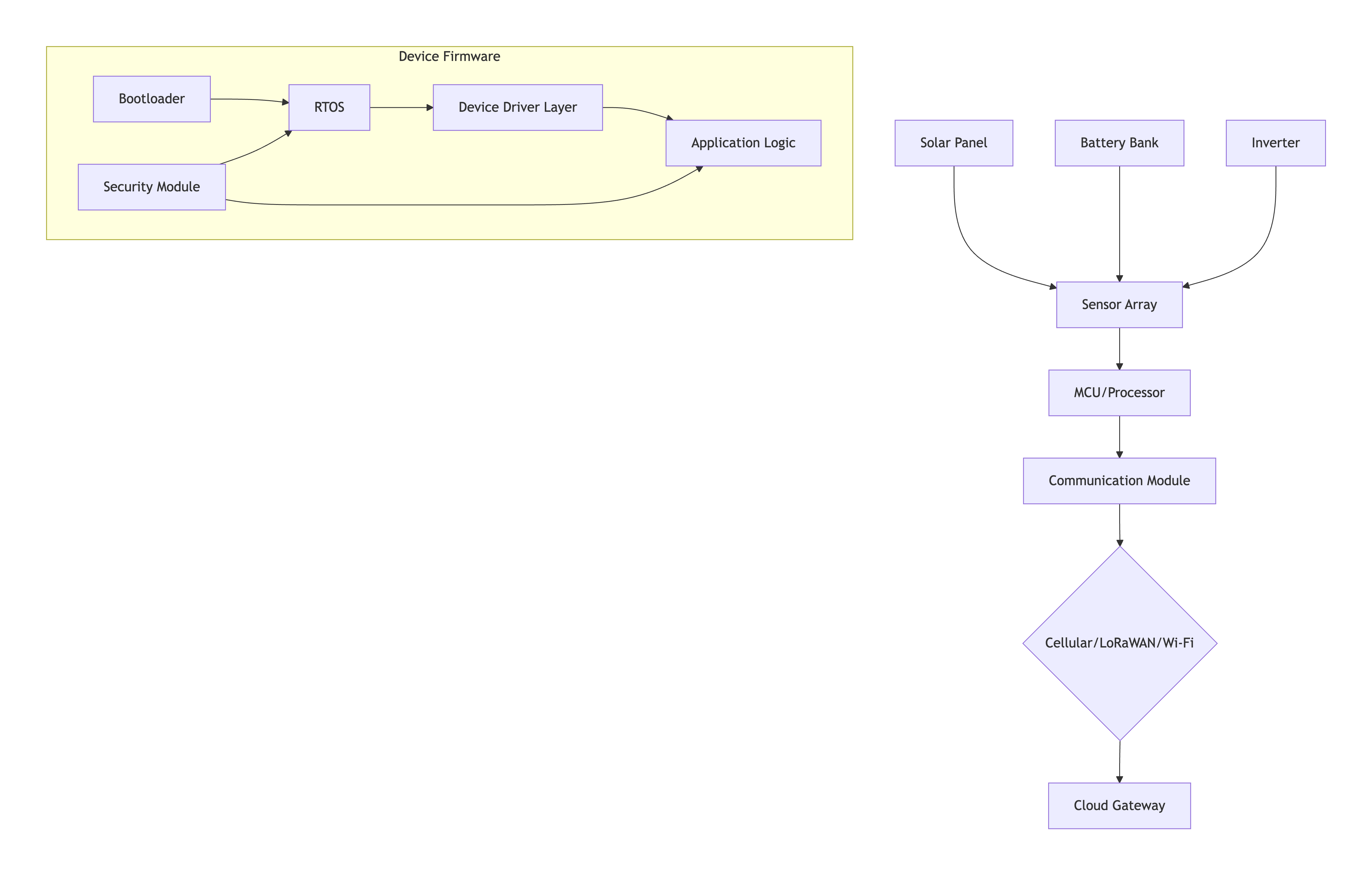
Device Specifications:
-
MCU: ESP32/STM32 with low-power modes
-
Sensors: INA219 (current/voltage), DS18B20 (temperature), light sensors
-
Communication:
-
Primary: LTE-M/NB-IoT for wide coverage
-
Secondary: LoRaWAN for remote areas
-
Backup: Wi-Fi for residential installations
-
-
Power: Self-powered with supercapacitor backup
Data Packet Format:
json
{
  "device_id": "SP-123456",
  "timestamp": "2024-01-15T10:30:00Z",
  "location": {"lat": 37.7749, "lng": -122.4194},
  "metrics": {
    "panel": {
      "voltage": 48.2,
      "current": 12.5,
      "temperature": 45.3,
      "irradiance": 850
    },
    "battery": {
      "soc": 78.5,
      "voltage": 52.1,
      "temperature": 28.4,
      "health": 92
    },
    "inverter": {
      "output_power": 5800,
      "efficiency": 96.7,
      "frequency": 60.01,
      "temperature": 42.1
    }
  },
  "status": "normal",
  "firmware_version": "2.1.4"
}
4.2 Communication Protocol Design
MQTT Topics Structure:
text
solar/<region>/<device_type>/<device_id>/<metric_type>
solar/us-west/panel/SP-123456/telemetry
solar/us-west/inverter/INV-789012/status
solar/eu-central/battery/BAT-345678/alerts
Message QoS Levels:
-
QoS 0: At most once - For non-critical telemetry
-
QoS 1: At least once - For configuration updates
-
QoS 2: Exactly once - For firmware updates, critical commands
CoAP for Constrained Devices:
python
# Example CoAP message for low-power devices
coap://gateway.solar.com/devices/SP-123456
Method: PUT
Payload: Binary encoded telemetry (CBOR/MessagePack)
Options: Observe for server-push updates
4.3 Data Ingestion Pipeline
python
class DataIngestionService:
    def __init__(self):
        self.mqtt_broker = MQTTServer()
        self.kafka_producer = KafkaProducer()
        self.device_registry = DeviceRegistry()

    async def handle_message(self, topic: str, payload: bytes):
        # 1. Validate and parse
        data = self.validate_payload(payload)

        # 2. Authenticate device
        if not self.authenticate_device(data.device_id, data.signature):
            raise AuthenticationError()

        # 3. Apply data schema
        normalized = self.apply_schema(data)

        # 4. Enrich with metadata
        enriched = await self.enrich_data(normalized)

        # 5. Publish to Kafka
        await self.kafka_producer.send(
            topic='solar-telemetry',
            key=data.device_id,
            value=enriched
        )

        # 6. Update device last seen
        await self.device_registry.update_heartbeat(data.device_id)

    def validate_payload(self, payload):
        # Check message integrity
        # Verify timestamp freshness
        # Validate data ranges
        pass
4.4 Real-time Processing Pipeline
scala
// Apache Flink job for real-time analytics
object SolarAnalyticsJob {
  def main(args: Array[String]): Unit = {
    val env = StreamExecutionEnvironment.getExecutionEnvironment

    val telemetryStream = env
      .addSource(KafkaSource.solarTelemetry())
      .keyBy(_.deviceId)
      .window(TumblingEventTimeWindows.of(Time.minutes(5)))

    // Calculate rolling statistics
    val statsStream = telemetryStream
      .process(new StatisticsCalculator())

    // Detect anomalies
    val anomalyStream = statsStream
      .flatMap(new AnomalyDetector())

    // Predict failures
    val predictionStream = statsStream
      .map(new FailurePredictor())

    // Output to multiple sinks
    statsStream.addSink(InfluxDBSink())
    anomalyStream.addSink(AlertServiceSink())
    predictionStream.addSink(PredictionStoreSink())
  }
}

class AnomalyDetector extends RichFlatMapFunction[DeviceStats, Alert] {
  // ML model for anomaly detection
  val model = loadModel("anomaly_detection_v1")

  override def flatMap(stats: DeviceStats, out: Collector[Alert]): Unit = {
    val features = extractFeatures(stats)
    val anomalyScore = model.predict(features)

    if (anomalyScore > THRESHOLD) {
      out.collect(Alert(
        device_id = stats.deviceId,
        severity = determineSeverity(anomalyScore),
        metric = stats.metric,
        value = stats.value,
        expected_range = stats.normalRange
      ))
    }
  }
}
4.5 Time-Series Data Storage
Database Schema Design:
sql
-- PostgreSQL for device metadata
CREATE TABLE devices (
    device_id VARCHAR(50) PRIMARY KEY,
    customer_id VARCHAR(50),
    installation_date TIMESTAMP,
    location GEOGRAPHY(Point, 4326),
    device_type VARCHAR(20),
    manufacturer VARCHAR(50),
    model VARCHAR(50),
    firmware_version VARCHAR(20),
    last_seen TIMESTAMP,
    status VARCHAR(20)
);

CREATE TABLE device_configurations (
    config_id SERIAL PRIMARY KEY,
    device_id VARCHAR(50) REFERENCES devices(device_id),
    config_key VARCHAR(100),
    config_value JSONB,
    applied_at TIMESTAMP,
    created_by VARCHAR(50)
);

-- InfluxDB/TimeScaleDB for time-series data
-- Continuous aggregates for performance
CREATE MATERIALIZED VIEW hourly_energy_production
WITH (timescaledb.continuous) AS
SELECT
    time_bucket('1 hour', time) AS bucket,
    device_id,
    avg(power_output) as avg_power,
    sum(energy_produced) as total_energy,
    percentile_cont(0.95) WITHIN GROUP (ORDER BY efficiency) as p95_efficiency
FROM solar_telemetry
GROUP BY bucket, device_id;
Data Retention Policy:
-
Hot storage (30 days): InfluxDB/TimeScaleDB for real-time queries
-
Warm storage (1 year): PostgreSQL with partitioning
-
Cold storage (7 years): S3/Data Lake for compliance
4.6 Analytics & Machine Learning Pipeline
python
# Batch analytics pipeline using Apache Spark
class EnergyAnalyticsPipeline:
    def __init__(self, spark_session):
        self.spark = spark_session
        self.feature_store = FeatureStore()

    def daily_processing(self):
        # 1. Load data from data lake
        df = self.spark.read.parquet("s3://solar-data/raw/")

        # 2. Feature engineering
        features_df = self.extract_features(df)

        # 3. Model training/inference
        predictions = self.run_ml_models(features_df)

        # 4. Store results
        predictions.write.parquet("s3://solar-data/analytics/")

        # 5. Update feature store
        self.feature_store.write_features(features_df)

    def extract_features(self, df):
        # Time-based features
        df = df.withColumn("hour_of_day", hour(col("timestamp")))
        df = df.withColumn("day_of_week", dayofweek(col("timestamp")))

        # Rolling statistics
        window_spec = Window.partitionBy("device_id").orderBy("timestamp").rowsBetween(-24, 0)
        df = df.withColumn("24h_avg_power", avg("power_output").over(window_spec))

        # Weather correlation
        df = self.join_weather_data(df)

        return df

    def run_ml_models(self, df):
        # Production prediction
        production_model = load_model("production_forecast")
        df = production_model.transform(df)

        # Failure prediction
        failure_model = load_model("failure_prediction")
        df = failure_model.transform(df)

        # Optimization recommendations
        optimization_model = load_model("optimization")
        df = optimization_model.transform(df)

        return df
ML Models Deployed:
-
Production Forecasting: LSTM/Transformer models
-
Anomaly Detection: Autoencoders + Isolation Forest
-
Failure Prediction: XGBoost with SHAP explanations
-
Panel Soiling Detection: Computer vision on thermal images
-
Energy Optimization: Reinforcement learning for battery scheduling
5. Scalability & Performance
5.1 Database Sharding Strategy
yaml
# Shard by region and device type
shard_key: <region_code>_<device_type>
shards:
  - us_west_panel: [shard01, shard02]
  - us_west_inverter: [shard03, shard04]
  - eu_central_panel: [shard05, shard06]

# Time-based partitioning
partitions:
  - current_month: PRIMARY
  - last_3_months: SSD
  - older: HDD/Archive
5.2 Caching Strategy
python
class MultiLayerCache:
    def __init__(self):
        self.l1_cache = RedisCluster()  # Hot data, 5ms access
        self.l2_cache = Memcached()     # Warm data, 10ms access
        self.cdn = CloudFront()         # Static assets, global

    async def get_device_state(self, device_id):
        # Check L1 cache
        state = await self.l1_cache.get(f"device:{device_id}:state")
        if state:
            return state

        # Check L2 cache
        state = await self.l2_cache.get(f"device:{device_id}:state")
        if state:
            # Populate L1 cache
            await self.l1_cache.set(f"device:{device_id}:state", state, ttl=60)
            return state

        # Read from database
        state = await self.db.get_device_state(device_id)

        # Update caches
        await self.l2_cache.set(f"device:{device_id}:state", state, ttl=300)
        await self.l1_cache.set(f"device:{device_id}:state", state, ttl=60)

        return state
5.3 Load Balancing Strategy
yaml
# Global load balancing
traffic_manager:
  routing_method: Performance
  endpoints:
    - us-east: weight=40
    - eu-west: weight=30
    - ap-southeast: weight=30

# Regional load balancing
application_gateway:
  rules:
    - path: /api/v1/devices/*
      backend_pool: device-service-pool
      health_probe: /health
    - path: /api/v1/analytics/*
      backend_pool: analytics-service-pool

# Service mesh load balancing
istio:
  destination_rules:
    - host: device-service
      trafficPolicy:
        loadBalancer:
          consistentHash:
            httpHeaderName: x-device-id
        outlierDetection:
          consecutiveErrors: 5
          interval: 10s
          baseEjectionTime: 30s
6. Security Architecture
6.1 Device Security
python
class DeviceSecurity:
    # Hardware Security Module (HSM) integration
    HSM_MODULE = ATECC608A

    def provision_device(self, device_id):
        # Generate device certificate
        private_key = self.HSM_MODULE.generate_key()
        csr = self.create_csr(device_id, private_key)
        certificate = ca_signer.sign_csr(csr)

        # Store in secure element
        self.HSM_MODULE.write_certificate(certificate)

        # Create device identity
        return DeviceIdentity(
            device_id=device_id,
            certificate=certificate,
            public_key=private_key.public_key()
        )

    def sign_telemetry(self, device_id, payload):
        # Create JWT with claims
        claims = {
            "device_id": device_id,
            "timestamp": datetime.utcnow().isoformat(),
            "payload_hash": sha256(payload).hexdigest()
        }

        # Sign with device private key
        token = jwt.encode(
            claims,
            self.HSM_MODULE.get_private_key(),
            algorithm='ES256'
        )

        return token
6.2 Network Security
text
┌─────────────────────────────────────────────────────────┐
│                    Security Layers                       │
├─────────────────────────────────────────────────────────┤
│  Application Layer │ API Keys, JWT, Rate Limiting       │
├─────────────────────────────────────────────────────────┤
│  Transport Layer  │ TLS 1.3, Mutual TLS, DTLS for CoAP  │
├─────────────────────────────────────────────────────────┤
│  Network Layer    │ IPsec VPN, Private APN, Firewalls   │
├─────────────────────────────────────────────────────────┤
│  Physical Layer   │ SIM Security, Secure Boot, TPM      │
└─────────────────────────────────────────────────────────┘
7. Fault Tolerance & Disaster Recovery
7.1 Circuit Breaker Pattern
java
public class DeviceServiceClient {
    private final CircuitBreaker circuitBreaker;

    public DeviceServiceClient() {
        this.circuitBreaker = CircuitBreaker.ofDefaults("deviceService");
    }

    public Mono<DeviceState> getDeviceState(String deviceId) {
        return Mono.fromCallable(() -> fetchDeviceState(deviceId))
            .transformDeferred(CircuitBreakerOperator.of(circuitBreaker))
            .timeout(Duration.ofSeconds(5))
            .onErrorResume(e -> getCachedState(deviceId))
            .retryWhen(Retry.backoff(3, Duration.ofSeconds(1)));
    }

    private DeviceState fetchDeviceState(String deviceId) {
        // Call remote service
        if (circuitBreaker.getState() == State.OPEN) {
            throw new CircuitBreakerOpenException();
        }
        return deviceServiceClient.getState(deviceId);
    }
}
7.2 Disaster Recovery Plan
yaml
recovery_strategy:
  rpo: 15 minutes  # Recovery Point Objective
  rto: 1 hour      # Recovery Time Objective

backup_strategy:
  - continuous: telemetry_data (S3 cross-region replication)
  - hourly: relational_data (RDS snapshots)
  - daily: ml_models (S3 versioning)

multi_region_deployment:
  primary_region: us-east-1
  secondary_region: eu-west-1
  tertiary_region: ap-southeast-1

failover_procedure:
  - step1: Detect region failure (health checks)
  - step2: Update DNS (Route53 failover)
  - step3: Promote standby database
  - step4: Redirect message queues
  - step5: Update service discovery
8. Cost Optimization
8.1 Data Transfer Costs
python
class DataOptimizer:
    def optimize_telemetry(self, device_data):
        # Adaptive sampling based on conditions
        if self.is_normal_operation(device_data):
            # Send every 5 minutes
            sampling_rate = 300
        elif self.is_anomaly_detected(device_data):
            # Send every 30 seconds
            sampling_rate = 30
        elif device_data.battery.soc < 20:
            # Critical battery, send every minute
            sampling_rate = 60

        # Data compression
        compressed = self.compress_with_protobuf(device_data)

        # Bundle multiple readings
        if self.should_bundle():
            return self.bundle_readings(compressed)

        return compressed

    def compress_with_protobuf(self, data):
        # Protocol Buffers for efficient serialization
        message = TelemetryMessage(
            device_id=data.device_id,
            timestamp=int(data.timestamp.timestamp()),
            voltage=int(data.voltage * 100),  # Store as integers
            current=int(data.current * 1000),
            temperature=int(data.temperature * 10)
        )
        return message.SerializeToString()
8.2 Compute Optimization
yaml
# Kubernetes Horizontal Pod Autoscaling
autoscaling:
  device-service:
    min_replicas: 3
    max_replicas: 50
    metrics:
      - type: Resource
        resource:
          name: cpu
          target:
            type: Utilization
            averageUtilization: 70
      - type: External
        external:
          metric:
            name: kafka_lag
          target:
            type: AverageValue
            averageValue: 1000

# Spot instances for batch processing
batch_jobs:
  use_spot_instances: true
  interruption_handling:
    checkpoint_frequency: 5 minutes
    save_intermediate_results: true
9. Monitoring & Observability
9.1 Metrics Collection
yaml

metrics:
  infrastructure:
    - cpu_utilization
    - memory_usage
    - disk_iops
    - network_throughput

  application:
    - request_latency
    - error_rate
    - throughput
    - queue_length

  business:
    - energy_produced_total
    - devices_online
    - anomaly_count
    - cost_savings

  device:
    - battery_health
    - panel_efficiency
    - uptime_percentage
    - data_transmission_success_rate
9.2 Distributed Tracing
python
from opentelemetry import trace
from opentelemetry.sdk.trace import TracerProvider

# Instrument services
tracer = trace.get_tracer(__name__)

class DeviceService:
    async def process_telemetry(self, device_id, data):
        with tracer.start_as_current_span("process_telemetry") as span:
            span.set_attribute("device.id", device_id)
            span.set_attribute("data.size", len(data))

            # Add context to logs
            logger.info(f"Processing telemetry",
                       extra={"device_id": device_id,
                              "trace_id": span.get_span_context().trace_id})

            try:
                result = await self.validate_and_store(data)
                span.set_status(StatusCode.OK)
                return result
            except Exception as e:
                span.set_status(StatusCode.ERROR)
                span.record_exception(e)
                raise
10. Deployment Strategy
10.1 Blue-Green Deployment
yaml
deployment_strategy:
  type: blue-green
  phases:
    - phase1: Deploy to canary (5% traffic)
      duration: 30 minutes
      validation: automated tests + metrics

    - phase2: Deploy to staging (100% test traffic)
      duration: 2 hours
      validation: integration tests

    - phase3: Deploy to production-blue (50% real traffic)
      duration: 1 hour
      validation: business metrics

    - phase4: Switch all traffic to green
      rollback_window: 15 minutes
      rollback_trigger: error_rate > 1% or latency > 2s
10.2 Device Firmware Updates
python
class FirmwareUpdateManager:
    async def rollout_update(self, firmware_version, target_devices):
        # 1. Validate firmware
        checksum = self.validate_firmware(firmware_version)

        # 2. Create rollout plan
        plan = self.create_rollout_plan(
            devices=target_devices,
            strategy="progressive_percentage",
            batch_size=1000,
            delay_between_batches=3600  # 1 hour
        )

        # 3. Execute rollout
        for batch in plan.batches:
            # Notify devices
            await self.notify_devices(batch.devices, firmware_version)

            # Monitor progress
            progress = await self.monitor_update_progress(batch)

            # Validate success
            if progress.success_rate < 95:
                await self.pause_rollout()
                await self.investigate_failures(batch)

                if self.is_critical_issue():
                    await self.rollback_batch(batch)

            # Wait before next batch
            await asyncio.sleep(plan.delay_between_batches)

        # 4. Final validation
        return await self.validate_rollout_completion()
11. Challenges & Solutions
Challenge 1: Intermittent Connectivity
Solution: Edge computing with local buffering
python
class EdgeProcessor:
    def __init__(self, storage_capacity=10000):
        self.buffer = CircularBuffer(storage_capacity)
        self.local_ml_model = OnDeviceMLModel()

    def process_locally(self, data):
        # Run ML inference locally
        anomaly = self.local_ml_model.detect(data)

        if anomaly:
            # Store in high-priority buffer
            self.buffer.add(data, priority=HIGH)
        else:
            # Store in normal buffer
            self.buffer.add(data, priority=NORMAL)

    async def sync_with_cloud(self):
        if self.is_connected():
            # Send high priority first
            high_priority = self.buffer.get_high_priority()
            await self.send_to_cloud(high_priority)

            # Then normal priority
            normal_priority = self.buffer.get_normal_priority()
            await self.send_to_cloud(normal_priority)

            self.buffer.clear_sent()
Challenge 2: Data Volume Management
Solution: Tiered data storage with intelligent sampling
sql
-- Automated data downsampling
CREATE CONTINUOUS AGGREGATE solar_telemetry_hourly
AS
SELECT
    time_bucket('1 hour', time) as bucket,
    device_id,
    avg(voltage) as voltage,
    avg(current) as current,
    max(temperature) as max_temp,
    sum(energy) as total_energy
FROM solar_telemetry
GROUP BY bucket, device_id
WITH (refresh_interval = '1 hour');


Comments (0)
No comments yet. Be the first to comment!